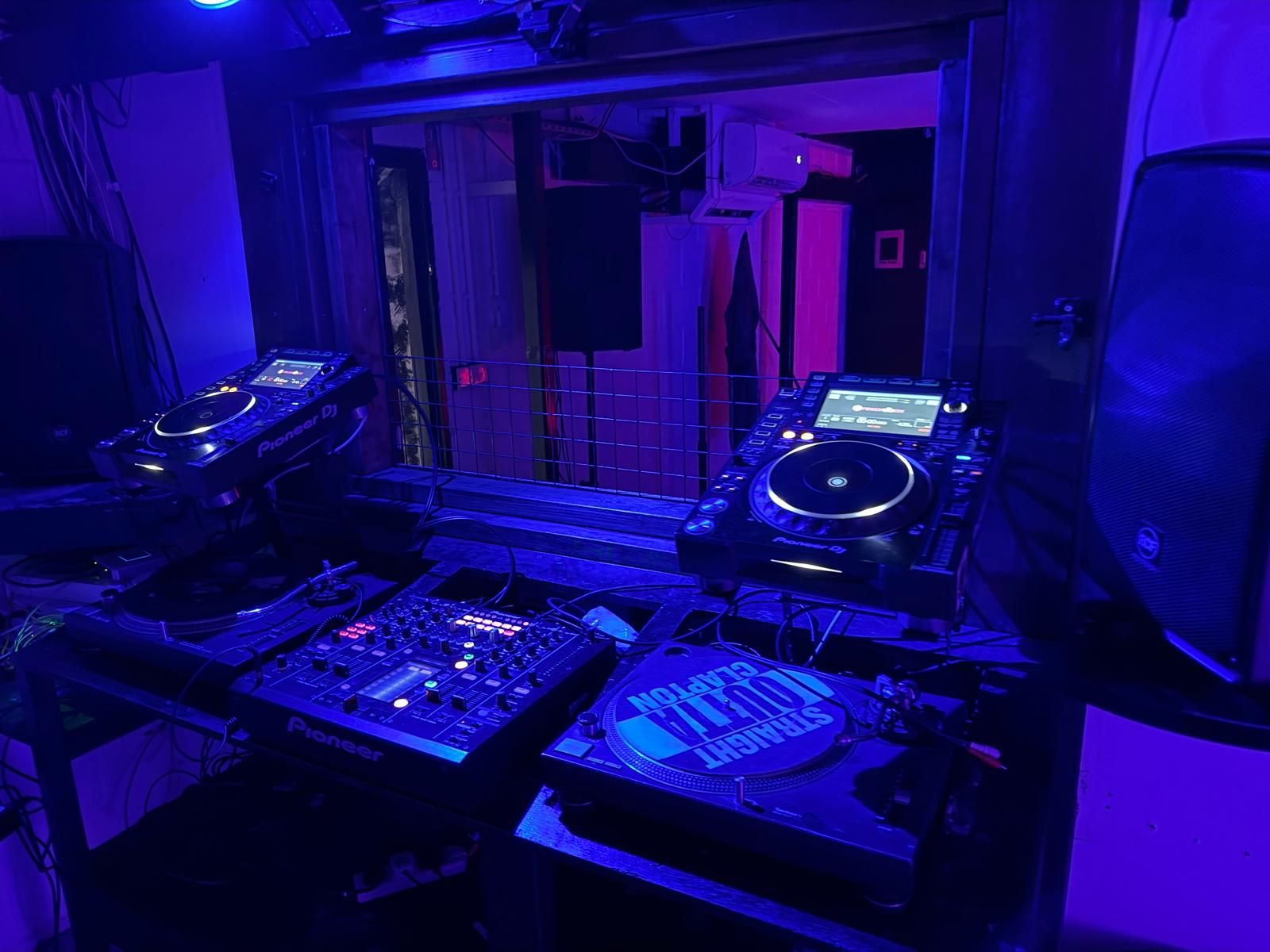
Your setup. Our stage.
If you are looking for DJ studio hire in London, the room matters as much as the decks. A controller in a bedroom can help you learn the basics. It will not prepare you for the feel of a proper club booth, the response of a full PA, or the pressure of recording a set in one take.
At @38, you get the real setup in a raw industrial space in Clapton · Hackney · London E5.
Pioneer CDJ multi-player decks. Turntables. Professional mixer. Full PA and monitor system. Atmospheric lighting. Full exclusivity.
Starting from £175.
No shared room. No white-box backdrop. No extra set build required.
What does “club-standard” actually mean?
Club-standard does not just mean owning a pair of expensive decks. It means using a setup that feels familiar when you walk into a professional booth.
The layout is simple:
- Two Pioneer CDJ multi-player decks
- A professional DJ mixer
- Turntables for vinyl or hybrid sets
- Main PA system
- Booth monitor system
- Proper signal flow between every part of the rig
This is the arrangement most DJs expect to see in a club, venue, or festival environment. The difference is that you can use it privately, without a crowd waiting for the next transition.
You can slow the session down. Repeat the same blend ten times. Test a new USB. Record the set again. Try the risky transition you would not attempt during a live booking.
That is the point of a proper DJ session.

Pioneer CDJ multi-player decks
A controller gives you access to the functions. CDJs give you the workflow.
You browse, load, cue, loop, pitch and mix using the same kind of setup you will find in professional clubs. The controls are spaced for movement. The screens give you the information you need without forcing you to stare at a laptop.
For a recorded set, this makes a difference. Your hands move naturally. Your performance looks more convincing on camera. You are not hiding behind a laptop while trying to make the set feel live.
Before your session, prepare your music library properly. Use rekordbox to analyse your tracks, check beat grids, set cue points and build playlists. Export your USBs before you arrive.
Bring two prepared USBs if you can. One is your working drive. The other is the backup. A corrupted USB is a bad reason to lose a booking.
Also bring:
- Your headphones
- Your preferred USBs
- Any laptop cables needed for a hybrid setup
- A short set plan
- Water (seriously)
You do not need to arrive with every transition mapped out. You do need to know what you want to test.
Turntables for vinyl and hybrid sets
Digital is fast. Vinyl is physical.
The turntable setup at @38 gives you room to work with records, DVS or a combination of both. You can build a set across formats instead of choosing one workflow and staying inside it.
Try a vinyl intro into a digital mix. Layer a familiar record under a new production. Test how your records sit against the full system. Record the result.
This is where a dedicated music production studio in Hackney can become more than a production room. You are not only making the track. You are hearing how it behaves in a performance environment.
That matters when you are preparing a release, filming a live set, or building a new show.
The equipment is already in the room. You do not need to organise separate deck hire, a mixer, monitors and a PA before you can start. Walk in. Connect your music. Play.
Full PA and monitor system
Headphones are useful. They are not the same as hearing the room.
A full PA lets you understand how your mix feels at volume. You hear the weight of the kick, the space around the vocal and the movement of the bassline. You notice problems that can disappear inside headphones.
The monitor system gives you a clear booth reference while the PA carries the wider sound. This helps you maintain control without constantly turning the main system up.
Use the session to check:
Low-end balance
Does the bass support the track or swallow it? Low frequencies can sound controlled in headphones and become overwhelming through a PA.
Transitions
Does the incoming track enter cleanly? Listen for clashes between kicks, basslines and vocals before the mix becomes crowded.
Effects
Reverb and delay can sound subtle in headphones but spread through a room. Keep the effects intentional. A little space often works harder than a full wash.
Gain levels
Keep your channel gains controlled. A clean mix with headroom will always sound better than a redlined master. The room is there to show you what is happening. Let it.

Full exclusivity. No interruptions.
A DJ session is easier when you can focus on the set.
At @38, the booking is exclusive. No other bookings sharing the space. No people walking through the background. No waiting for someone else to finish using the equipment.
That gives you control over the whole session.
You can record a full set from start to finish. You can bring a small team for filming. You can set up cameras around the booth and use the viewing window from the adjacent room for a different angle. You can rehearse without feeling like someone is watching the clock.
The main floor has a 170-person capacity, so it works for more than private practice. Use it for:
- A recorded DJ set
- A livestream
- A rehearsal before a headline show
- A label or artist showcase
- A listening session
- A hybrid live performance
- A small crowd-based content shoot
The lighting is already part of the space. Red, purple, teal and blue washes work across the industrial surfaces, giving your footage depth without a separate set build.

Why hire a DJ studio instead of a blank room?
A blank room creates extra work.
You need to source the equipment, move it into position, test every connection, build the look, and solve problems before the first track plays. That can turn a short booking into a production day.
A purpose-built DJ studio removes those steps.
At @38, the equipment and environment are already there. You get the decks, mixer, turntables, PA, monitors and lighting in one private space. The raw brick, dark surfaces and steel structure do the visual work.
That is useful for DJs who need content as well as sound.
You can arrive with a camera operator, set up a few angles and record a set that looks like it belongs in a venue. You can bring a photographer and capture stills during the same booking. You can test a live concept before taking it to a larger room.
One booking. More usable output.
How to prepare for your session at @38
Do these five things before you arrive:
- Prepare your USBs. Analyse your tracks and export your playlists.
- Bring a backup. Two USBs are better than one.
- Plan the purpose. Decide whether you are rehearsing, recording, streaming or testing new music.
- Bring your headphones. Use the pair you know.
- Allow time for soundcheck. Do not use every minute on setup. Leave space to listen.
If you are filming, bring a simple shot list. A wide shot, a booth angle and a close-up of the decks will give you useful coverage without overcomplicating the day.
If you are recording audio, keep your gains clean and avoid changing the room volume every few minutes. Consistency makes the final edit easier.
For more preparation tips, read The DJ’s Guide to Mastering Pioneer CDJs at @38.
Book the decks in Hackney
@38 is a raw industrial creative space in Clapton E5, built for DJs who need more than a practice room.
You get:
- Pioneer CDJ multi-player decks
- Turntables
- Professional DJ mixer
- Full PA and monitor system
- Atmospheric lighting rig
- 170-person main-floor capacity
- Full exclusivity
- No set build required
DJ sessions start from £175.
Check the DJ setup or book the decks. Send us your date and what you are planning. We respond within 24 hours.
Then tell us in the comments: what is your go-to track for testing a club system? The track that exposes the low end. The vocal that tells you if the room is clear. The one you always load first.
Comment below with your choice, then DM us to book the decks at @38.
Leave a Reply