A strong music video location does part of the production work for you.
The right space gives the camera texture, depth and atmosphere before you bring in a single prop. The wrong one creates extra costs: set dressing, lighting fixes, crew movement problems and hours spent hiding plain white walls.
If you’re scouting a music video location in London, ask these 10 questions before you book an industrial space.
1. Is the texture already there?
Start with the walls, floors and fixed details.
Does the space have raw brick, dark timber, concrete, steel or worn surfaces that will read on camera? Or are you looking at a blank warehouse that needs a full art department to give it character?
Texture gives your director and DP more options. Wide shots feel less empty. Close-ups have something behind them. Light catches uneven surfaces in a way it cannot catch on a flat studio wall.
Ask to see the space in person, not only through heavily graded photographs.
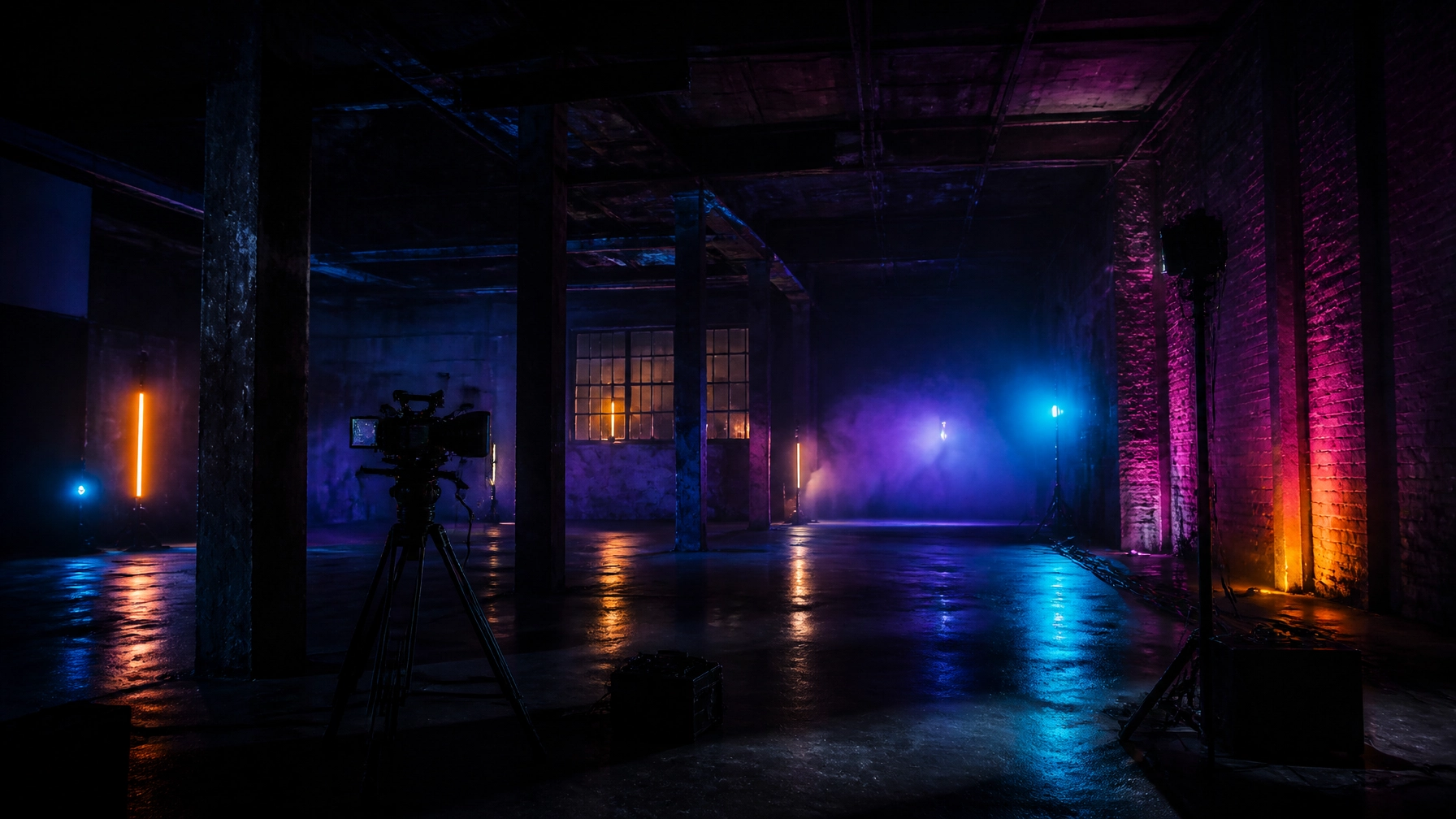
At @38, the main floor has raw brick, dark wood floors and industrial surfaces already in place. The look is built into the room. No set build required.
2. What does the lighting look like on camera?
A room can look dramatic in person and flat on camera.
Check where the natural light enters. Look at the windows, ceiling height, practical lights and existing colour washes. Ask whether the venue has a lighting rig, track lighting or enough room for your own kit.
You should also ask:
- Can the house lighting be changed?
- Are coloured lights included?
- Can you black out the windows?
- Is there space for stands, modifiers and cable runs?
- Does the lighting work for both wide shots and close-ups?
A good industrial location should give you a base look without limiting your own setup.
@38 uses dramatic coloured lighting in purple, red, teal and blue. You can use the existing atmosphere or bring your own fixtures through the track lighting and power points.

3. Can you get exclusive access?
Exclusivity affects the whole day.
If another booking is running next door, you may have noise bleed, people crossing the frame, limited access to shared areas and less control over the schedule. That can slow down a music video shoot quickly.
Ask exactly what “exclusive” means. Does it include:
- The full floor?
- The entrance and holding areas?
- The toilets and changing space?
- The lighting rig?
- Load-in and parking areas?
- The whole building or only one room?
At @38, shoot bookings include full main-floor exclusivity. Your crew, artist and equipment are the only production using the space during the booking.
That matters when you’re shooting performance takes, moving a large camera package or working with a full cast.
4. What’s the capacity for cast and crew?
A location may look spacious until everyone arrives.
Count the people involved in the real production. That includes the artist, dancers, extras, director, DP, camera team, lighting team, art department, HMU, wardrobe, production assistants and catering.
Then consider the equipment:
- Camera and lens cases
- Lighting stands
- Dolly or track
- Monitors and video village
- Wardrobe rails
- Props
- Bags and personal kit
@38 has a 170-person main floor, which gives you room to scale from a small performance shoot to a larger cast setup. It also gives the camera more distance for wide frames.
For a smaller shoot, the extra room still helps. You can separate the holding area, gear staging and active set instead of stacking everything into one corner.
5. Is there a clean second look?
One location should give you more than one frame.
Ask whether the space has a clean secondary area for cutaways, wardrobe changes, close-ups or a different performance setup. It does not need to look completely different. A change in wall texture, lighting colour or camera direction can be enough.
Look for:
- A separate room
- A stairway or corridor
- A bar or lounge area
- A darker corner
- A plain wall for inserts
- A different floor or ceiling treatment
This is where industrial spaces can work hard. One raw room can deliver several visual treatments with a lighting change and a new camera position.

At @38, the main floor, DJ booth, lounge areas and studio room give you options within the same building. You can keep the visual language consistent while changing the shot.
6. What’s the acoustics situation?
Music videos are visual productions, but sound still matters.
You may need playback for the artist, dancers or extras. You may also be capturing behind-the-scenes content, dialogue, live vocals or social clips during the day.
Ask about:
- Traffic noise
- Trains and aircraft
- Nearby businesses
- Air conditioning
- Building reverberation
- Noise restrictions
- Playback volume
- Any curfew for loud activity
Large industrial rooms can sound lively, but hard surfaces may create unwanted echo. If you plan to record clean dialogue or live audio, check whether the venue has a separate controlled room.
@38 has a dedicated studio room with controlled acoustics, separate from the main floor. That gives you a practical option for interviews, voiceover, livestreams or clean production audio alongside the main shoot.
For a location-specific guide, Studio @38 sets out the room’s access, acoustics and booking options.
7. How much set build is needed?
Ask what has to be built, dressed or hidden before you can shoot.
Every extra set element adds time, crew and budget. That may be the right call for a highly designed concept. But if you’re trying to keep the production lean, choose a space that already carries the mood.
Check whether you need to bring:
- Backdrops
- Flats
- Furniture
- Draping
- Props
- Practical lights
- Flooring
- Temporary walls
- Branding or signage
Then ask what the venue allows. Can you move furniture? Tape to the floor? Hang lightweight items? Use haze? Bring in a small set piece?
@38 is designed for productions that need more than a white box without building a full set. Raw brick, dark wood, industrial structures and coloured lighting are already part of the location.
The set you couldn’t build. Already there.
8. Is there power and load-in access?
This is one of the questions that can make or break the day.
Ask where the sockets are, how much power is available and whether the supply works for your lighting package. Find out if you can run cables safely without blocking walkways or fire exits.
Also check the load-in route:
- Can vans stop outside?
- Are there stairs or narrow doors?
- Is there a lift?
- How close is the entrance to the shooting floor?
- What time can you arrive?
- Can cases stay on site during the booking?
@38 has power throughout the main floor and access from 08:00 Monday to Sunday. Equipment van parking is available by arrangement.
Put the load-in plan in writing before the shoot. It is easier to solve a cable or parking issue during the recce than at call time.
9. Where is it and can crew park?
London locations can look close on a map and still be difficult for a full crew.
Check the nearest public transport, road access, parking restrictions and loading arrangements. Share the exact postcode with every department before the shoot. Ask whether cast cars, production vans and lighting vehicles can stop nearby.
@38 is in Clapton E5, Hackney. That gives you an East London industrial setting without moving the production far outside the city.
Parking is available by arrangement for equipment vans. Confirm the details with the venue team when you enquire.
For larger productions or branded shoots, you can also review Events @38 if the brief needs wider access, audience capacity or a full-venue setup.

10. What’s the rate and what’s included?
Get the full number before you commit.
Ask whether the quote includes exclusive access, lighting, furniture, power, changing space, parking, cleaning and overtime. Confirm the booking window too. “Half day” can mean different things from one venue to another.
At @38:
- Half Day: £600
- Up to 4 hours
- Exclusive main-floor access
- DJ booth backdrop included
- Studio room available for talent and changing
- Coloured lighting rig and track lighting
- Power throughout
- Parking by arrangement
A full day is £1,100 for up to 8 hours, with exclusive access from 08:00.
You can see the current details on the Shoots @38 page. If you have a larger production, recurring campaign or multi-day brief, ask for a tailored quote.
The right location removes work
Scouting is not only about finding somewhere that looks good in a still photograph.
You need a location that works for the whole production: the concept, the camera, the lighting, the cast, the crew, the schedule and the budget.
A strong industrial photoshoot location in London should give you visual character without forcing you into a heavy set build. It should have enough access and power to keep the day moving. It should offer more than one usable frame.
That is the point of @38.
Dark industrial surfaces. Dramatic coloured lighting. Full exclusivity. A 170-person main floor. Clapton E5.
From £600 for up to 4 hours.
Book a shoot day at @38, or DM @38 with your date and production brief. We respond within 24 hours.
What is the first question you ask when scouting a music video location? Comment below with the question that has saved your production : or the one you wish you had asked earlier.
Leave a Reply