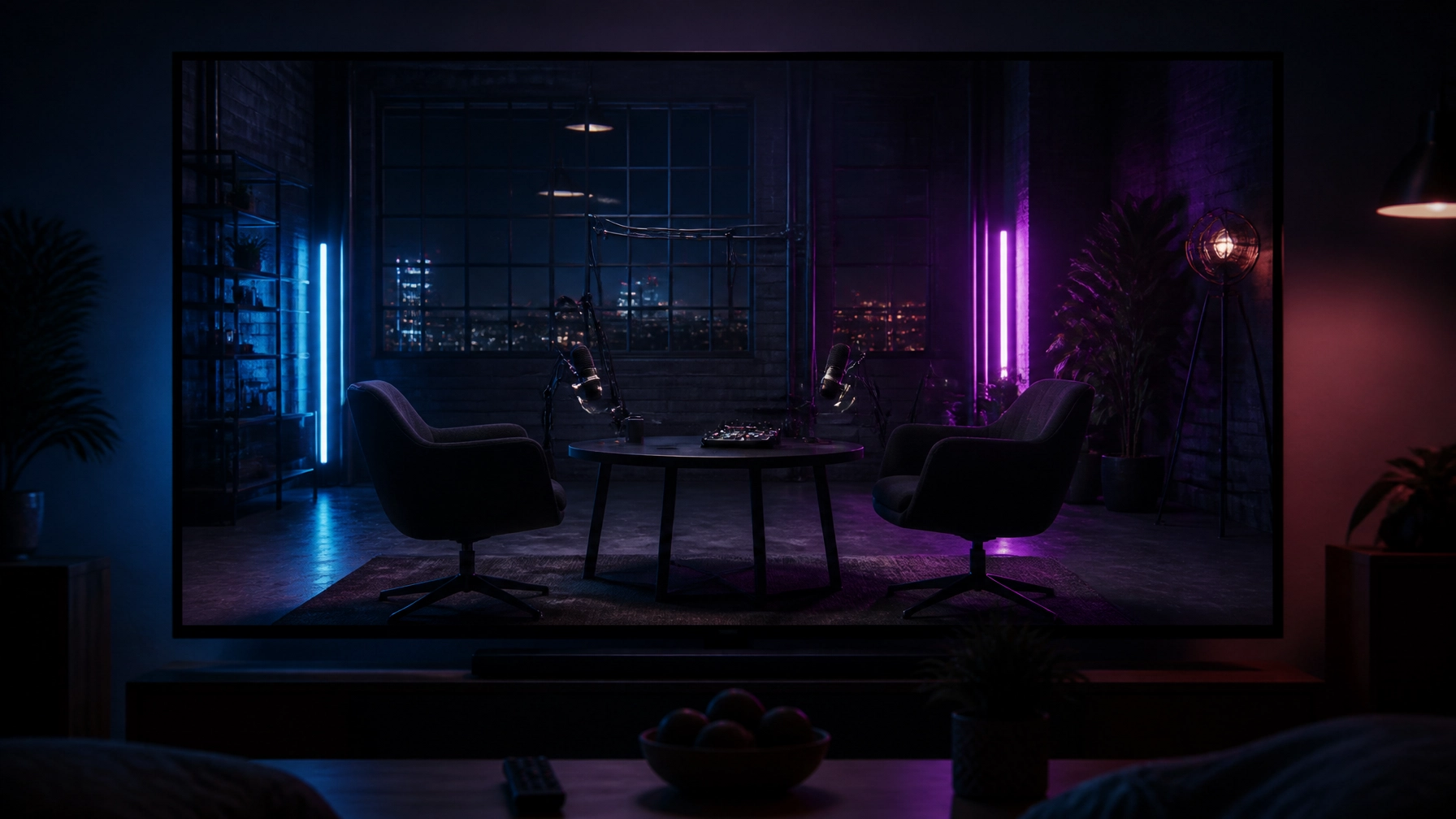
The living room test is simple.
Would your podcast still look good on a television across the room?
Not on a phone held 30 centimetres from someone’s face. Not in a thumbnail. On a 55-inch screen, with the lights down and the viewer watching from the sofa.
First, a correction on the stat.
Edison Research does not report that 45% of UK podcast consumers watch on smart TVs. Its latest UK research puts smart TV as the primary listening device at around 10%, while 72% of weekly podcast consumers actively watch video podcasts. The 45% figure relates to smart speaker ownership, not smart TV viewing.
The wider point still stands. Podcasting is no longer audio-only. More people are watching. More people are watching at home. The frame, the lighting and the room now carry part of the show.
That changes how you should book and use a podcast studio.
Your podcast is being judged from the sofa
A podcast can sound clean through headphones and still look unfinished on a television.
Viewers notice:
- Uneven lighting across faces
- Distracting backgrounds
- Blown-out highlights
- Flat colours
- Visible echo in the room
- Microphones positioned too far away
- A wide shot with no visual structure
On a phone, some of these details disappear into a small screen. On a television, they become part of the experience.
The living room viewer has time to look around the frame. They see the wall behind you. They see whether the shadows feel intentional. They notice if the background looks like a podcast set or a spare office.
This is why a podcast studio hire in London needs to offer more than a table, two chairs and a pair of microphones.
The room has to work on camera.
1. Frame for the screen people actually use
A good podcast frame has a clear hierarchy.
The viewer should see:
- The guest
- The host
- The microphones
- Enough background to establish the world of the show
Everything else needs a reason to be there.
Start with the seating. Keep both people at a comfortable angle to camera. Avoid placing them too close to a wall. Give the background some depth, but do not fill every inch of the frame with props.
The wide shot should establish the room. The tighter shots should carry the conversation.
This is especially important for long-form shows. A viewer may be watching for an hour. The frame needs texture, but it also needs to stay calm.
At @38, the dedicated podcast room uses two Wassily chairs beneath an industrial A-frame structure. The shape gives the frame structure without requiring a set build. The room already has a visual identity before you bring in a prop.

2. Let the lighting create depth
Lighting for a living room screen is not about making everything bright.
It is about controlling what the viewer looks at.
A flat, fully lit room loses depth. A room with uncontrolled darkness loses faces. The balance sits between the two: clear skin tones in the foreground, deeper shadows and colour in the background.
Purple-to-red studio lighting works because it separates the subject from the room. The colours give the background a controlled glow while leaving enough contrast around the faces.
The key word is controlled.
Red and purple light can quickly become too intense on camera. Saturated areas may lose detail. Bright practicals can blow out. Reflective surfaces can pull attention away from the conversation.
Use coloured light as a wash, not a distraction.
Keep faces readable. Keep the background darker. Let the industrial details sit inside the shadows rather than competing with the speakers.
A large television will expose bad lighting decisions quickly. If the background is brighter than the subject, the eye goes there first. If every surface is the same brightness, the frame feels flat.
The aim is simple: make the people clear and let the room provide the atmosphere.
3. Choose a backdrop that does not need dressing
A white wall gives you a blank canvas. It also gives you a set-building problem.
You may need to add:
- Lighting
- Texture
- Furniture
- Shelving
- Artwork
- Practical objects
- Branding
- Colour
That takes time. It also creates more decisions on the day.
An industrial backdrop does some of the work for you.
Exposed timber, dark metal, brick, concrete and structural details add texture without becoming a visual maze. They give the camera something to hold onto between cuts.
The backdrop still needs to be checked. Raw does not mean random. Look for:
- Clean sightlines
- No distracting objects behind heads
- No bright edges pulling focus
- Enough separation between people and background
- Texture that holds detail without becoming noise
The best room is ready before the cameras arrive.
At @38, dark industrial surfaces, cage partitions and coloured light create a background that reads clearly without additional set building. You can bring your own brand elements, but you are not starting with an empty box.

4. Keep the audio controlled
The living room test is visual, but bad audio will still end the session.
Television speakers make room problems obvious. Echo sits around every word. Background noise becomes part of the show. A microphone placed too far away captures more room than voice.
Your recording studio needs controlled acoustics.
That means:
- No obvious echo
- No bleed from another booking
- Microphones close enough to capture the voice properly
- Stable positioning throughout the conversation
- A room quiet enough for edits and clean dialogue
Broadcast-quality microphones are part of the visual language too. The microphone tells the viewer that this is a considered production. It gives the host and guest a clear place to speak.
But the microphone should not block the face or dominate the frame. Boom arms need to be positioned for both sound and composition.
This is where a dedicated recording studio in Hackney is different from a bedroom, office or improvised living-room setup. The room is designed around the conversation. You should not have to choose between clean sound and a usable frame.
5. Build for long-form viewing
A podcast episode may be recorded in one afternoon. It may then be watched in pieces over several weeks.
That means the setup needs to survive repetition.
Keep the visual language consistent:
- Same seating
- Same microphone positions
- Same lighting direction
- Same background
- Same colour palette
- Same camera logic
Consistency makes a show easier to recognise. It also makes a series easier to produce.
A fixed room helps. You can return to the same setup without rebuilding the frame every time.
At @38, the podcast room is independent of the main floor. It includes twin broadcast-quality boom-arm microphones, adjustable purple and red lighting, two Wassily chairs and controlled acoustics. The room is private during your session.
Book it for one episode, a run of interviews or a full series.

The @38 setup
The studio room at @38 is built for the living-room viewer.
You get:
- Twin broadcast-quality boom-arm microphones
- Two Wassily chairs
- Adjustable purple and red studio lighting
- Controlled acoustics
- A private room independent of the main floor
- Full exclusivity during your session
- Access from 08:00, Monday to Sunday
The room works for long-form conversations, solo shows, panel recordings, interviews and video-led media production.
Rates are clear:
- Half Day: £175 , up to 4 hours
- Full Day: £300 , up to 8 hours
- Series packages: available for recurring bookings
Located in Clapton E5, @38 gives you a prepared room with a dark industrial look. No grey curtain. No emergency set dressing. No need to turn a spare room into a studio before the guest arrives.

Run the living-room test before you publish
Before you lock the edit, watch a section of the episode on a television.
Do not watch it at your desk.
Sit back. Turn the volume down. Look at the frame from a distance.
Ask:
- Can you see both faces clearly?
- Does the background support the conversation?
- Are any highlights too bright?
- Do the colours feel deliberate?
- Does the room look consistent with the subject?
- Can you listen without noticing the acoustics?
- Would you keep watching for another 30 minutes?
If the answer is no, the problem may not be the edit.
It may be the room.
Book the room
Video podcasting is moving into the living room. Your studio needs to work there.
Book the Podcast Studio at @38 for from £175 for up to 4 hours, or check the Studio Room for longer recording and media production sessions.
You can book a podcast session directly. We respond within 24 hours.
Where do you watch podcasts : phone, laptop or television? Comment below and tell us what makes you stay with a show. Then DM @38 or start your booking at at38.org.
Leave a Reply