A good location looks right in the deck.
A shoot-ready location works when the crew arrives.
That means more than exposed brick, steel beams and a strong background. Your music video location in London needs to handle lights, cameras, cast, crew, equipment and time. Your industrial photoshoot location in London needs to support the frame without slowing everyone down.
Use this checklist before you lock the date.
At @38, Clapton · Hackney · London E5, the space is built around these practical requirements. You get full exclusivity, 170-person capacity, industrial surfaces and no set build required.
Half Day , up to 4 hours: From £600.
1. Power and distribution
The lights need to stay on
A location can have plenty of sockets and still fail the power check.
Before booking, confirm:
- Where the main distribution board is.
- Which circuits serve the shooting area.
- Whether outlets are accessible and working.
- How much power your lighting, camera, sound, hair and makeup teams need.
- Who can reset a breaker during the shoot.
- Whether the circuits are shared with HVAC, catering or other high-draw equipment.
- Whether temporary cabling can be safely run and taped down.
Do not wait until the first lighting setup to discover that the key light and the steamer are sharing one overloaded circuit.
Ask for the power plan. Walk the cable routes. Identify where the crew can stage distro without blocking doors, exits or camera movement.
For a music video, this matters even more. A larger lighting package, haze, monitors and playback equipment can put pressure on a space quickly.
At @38, the venue is set up for content production, recording and events. Still, send your equipment list before the booking. The right location conversation starts with the actual production requirements.
2. Load-in access
The fastest shoot is the one that starts on time
Look beyond the front door.
A location scout should walk the entire route from vehicle to set. Measure:
- Entrance width and height.
- Door access and opening times.
- Corridor widths.
- Turns and bottlenecks.
- Stairs, lifts and ramps.
- Floor condition.
- Distance from unload point to the shooting area.
- Secure places for empty cases and equipment carts.
A camera package may fit through a door. A full grip van may not.
Your crew should not be carrying heavy stands through a narrow public entrance while talent waits in the street. That costs time and creates unnecessary risk.
Ask where cases can go once they are unloaded. Ask where production can stage wardrobe, makeup, catering and client holding. These details do not make the moodboard. They make the day run.

3. Sightlines and lens angles
Walk the frame before you book the room
The space may look large from the entrance and tight through a lens.
Bring the shot list. Bring the camera plan. If possible, bring the cinematographer or photographer.
Check:
- How wide the cleanest angles are.
- Whether you can shoot long, medium and close coverage.
- Where the camera can physically stand.
- Whether columns, furniture or fixed structures block the frame.
- How much distance you have between subject, camera and background.
- Whether tracking, handheld or gimbal movement is possible.
- Whether the background holds up at different focal lengths.
- Whether the space gives you more than one usable look.
A strong industrial photoshoot location in London should give you depth. Not just one textured wall.
Look for layered backgrounds: foreground shadow, subject position, structural lines and a second surface behind them. Exposed brick, metal, concrete and industrial lighting can create separate looks without a full set change.
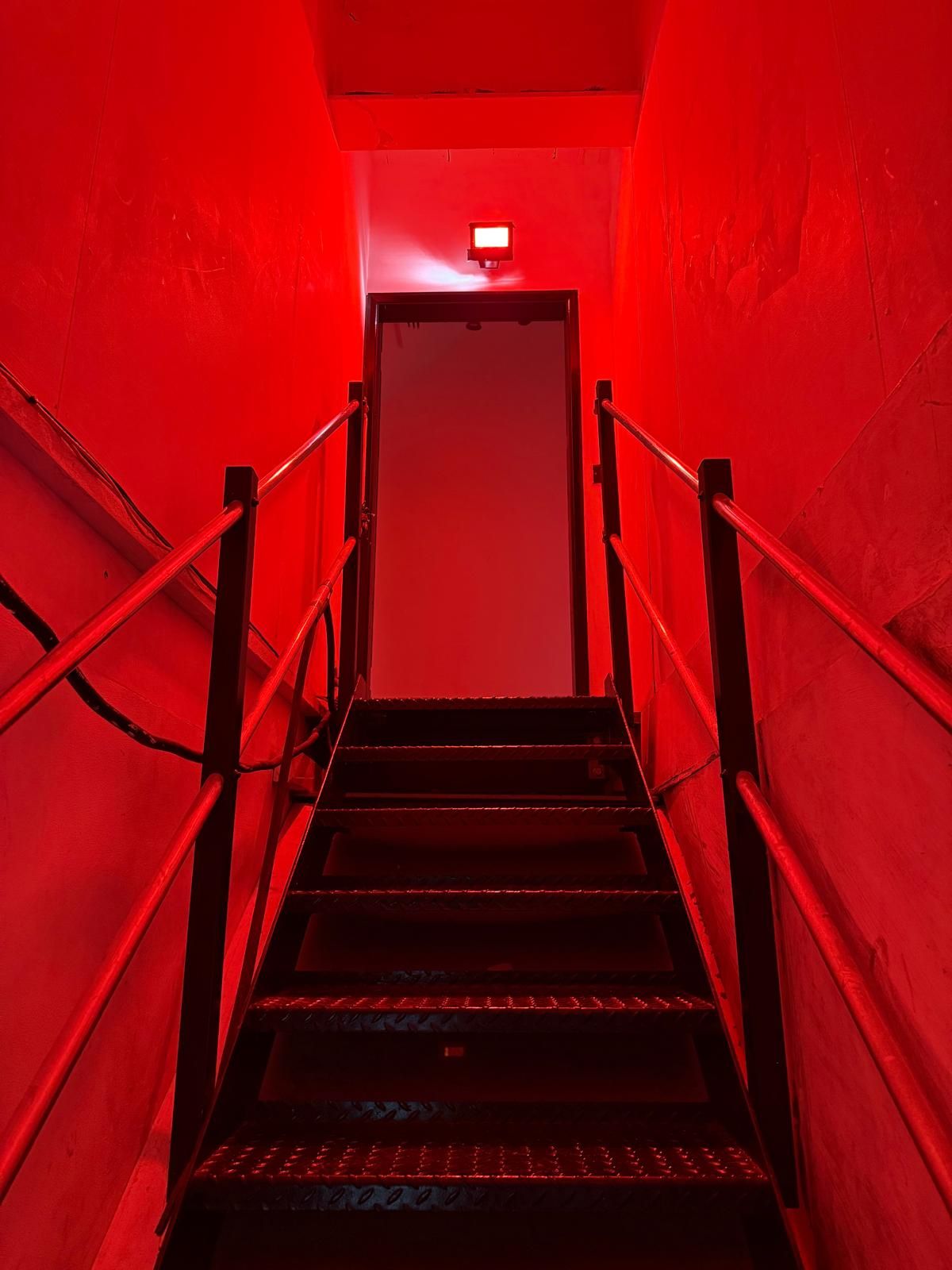
At @38, the architecture does the work. Dark surfaces, metal structures and coloured lighting give you a finished visual language from the first setup.
Read more about avoiding common industrial photoshoot mistakes.
4. Ceiling height
Measure to the lowest obstruction
Do not measure from the floor to the highest visible point.
Measure to the lowest beam, pipe, duct, sprinkler, cable tray or lighting obstruction.
You need to know whether there is room for:
- Overhead lighting.
- A boom operator.
- Tall stands.
- Large softboxes.
- Rigging or hanging practicals.
- Camera cranes, jibs or elevated movement.
- Safe crew circulation around the setup.
A high ceiling gives the image scale. It also gives the crew options.
A low ceiling can still work. You just need to know early. Some lighting plans will need to move from overhead to side light. Some wide shots may need a different lens or camera position.
Scout the vertical frame, not just the floor plan.

5. Acoustic control
The room may look silent. Listen anyway.
Hard industrial surfaces create visual depth. They can also create reverb.
During the scout, stop talking. Listen for:
- Traffic.
- Trains.
- Neighbouring units.
- Building machinery.
- HVAC.
- Fridges.
- Lift movement.
- Doors and shutters.
- Footfall from nearby spaces.
- Alarms or timed systems.
If you are filming dialogue, interviews or live performance, ask what can be switched off and who controls it.
Test it. Do not rely on “it should be quiet on the day.”
For music videos, playback and performance sound may be less critical than sync dialogue. For branded content, fashion films and interviews, clean production audio can change the entire location decision.
The right space gives you options: control the room, schedule around noise and dampen reflective areas when needed.
6. Light control
Character is useful. Uncontrolled light is not.
Natural light can be a benefit. It can also destroy continuity.
Map every source:
- Windows.
- Skylights.
- Roller shutters.
- Open doors.
- Streetlights.
- Adjacent buildings.
- Practical fixtures.
- Coloured LEDs.
- Reflections from concrete, glass or metal.
Then ask whether you can control it.
Can the room go dark for a night scene? Can you block daylight? Can you isolate practicals? Can you create two distinct looks without rebuilding the whole space?
An industrial location should give you texture to shape, not a flat room to fight.
Use directional light across brick and concrete. Let parts of the space fall into shadow. Use magenta, cyan or warm amber as accents rather than washing every surface in colour.
At @38, the dark industrial aesthetic is already part of the space. The lighting can stay low-key and contrast-heavy, with coloured highlights against deep charcoal and midnight tones.
For more visual planning, see where London music videos are being shot in 2026.
7. Cast and crew capacity
Capacity is more than a number
A location may hold 170 people. That does not mean 170 people can stand around one camera setup.
Plan the working space for:
- Cast and background talent.
- Director and production team.
- Camera and lighting crew.
- Hair, makeup and wardrobe.
- Clients and agency teams.
- Catering.
- Equipment storage.
- Talent holding.
- Breaks and circulation.
You need clear routes between set, holding and amenities. You also need to keep cases and people away from exits.
@38 has a 170-person capacity, making it suitable for larger music video productions, fashion shoots, brand content and event-led filming. Full exclusivity means your team controls the booking. No other production crossing through the frame. No shared floor competing for sound or access.
8. Parking and transport
Check how everyone gets there
Clapton E5 is well placed for East London crews, but transport still needs planning.
Confirm:
- Where production vehicles can stop.
- How long unloading can take.
- Whether vans can remain nearby.
- How crew and talent arrive by public transport.
- Where equipment can be held securely.
- Whether parking restrictions apply.
- Whether late arrivals can access the space without disrupting a take.
Send the access instructions with the call sheet. Include the exact entrance, arrival window and contact number.
A good location is not just photogenic. It is findable.

9. Exclusivity and control
Protect the frame
Ask exactly what you are booking.
Is it one room? One floor? A shared venue? Are other bookings running at the same time? Can members of the public enter? Who controls the doors, music and lighting?
Full exclusivity gives you control over:
- Background movement.
- Noise.
- Lighting continuity.
- Talent privacy.
- Equipment security.
- Schedule changes.
- Client viewing.
- Breaks between takes.
This is especially important for a music video location in London, where performance setups often need a wide frame, loud playback and repeated takes.
At @38, bookings are exclusive. Your setup. Our stage.
10. Rate and inclusions
Get the real number before you lock the date
A low headline rate can become expensive when every practical item is added separately.
Ask what the rate includes:
- Access hours.
- Setup and breakdown time.
- Power.
- Furniture.
- Lighting.
- Sound or playback equipment.
- Cleaning.
- Security.
- Parking.
- Site support.
- Overtime.
- Cancellation terms.
- Insurance requirements.
At @38:
- Half Day , up to 4 hours: From £600
- Full exclusivity
- 170-person capacity
- Clapton · Hackney · London E5
- Raw industrial surfaces
- No set build required
- Response within 24 hours
For larger productions, confirm the full production brief before booking. The rate should match the crew size, equipment package and access required.
The final scout
Before you approve the location, ask one simple question:
Can the production arrive, load in, light, shoot, reset and leave without fighting the space?
If the answer is yes, you have more than a good-looking location. You have a working production base.
That is what makes an industrial space shoot-ready.
At @38, you get the texture of a raw industrial venue with the practical setup needed for commercial shoots, fashion content, interviews, music videos and larger productions.
No white box. No unnecessary set build. No other booking in the frame.
Check your date or book a shoot day. We respond within 24 hours.
What would you add to this location scout’s checklist? Comment below with the detail that has saved : or ruined : a shoot day. Then DM us or book at at38.org.
Leave a Reply