A good photoshoot location does some of the work before the camera comes out.
You should not need to build a fake wall, dress a room, or spend half the booking hiding a blank studio. You need surfaces with texture. Light with direction. Corners that already have a point of view.
That is the idea behind the main floor at @38, a raw industrial photoshoot location in London, Clapton E5.
The space is available from £600 for a half day : up to 4 hours. You get exclusive access to the main floor, dramatic coloured lighting, track lighting, power throughout, and a studio room for talent or changing.
No set build required.
Here are 15 backdrops you can use on day one.
1. Exposed brick walls
Start with the wall that already has history in it.
Raw brick gives portraits, fashion editorials, product campaigns, and music content a surface that a printed backdrop cannot match. Keep the light hard and directional for deep shadows. Or wash the brick with colour and let the texture do the work.
Use it for:
- Full-length portraits
- Streetwear lookbooks
- Artist press shots
- Product close-ups
- Editorial stills
The brick works in both colour and black and white. That makes it useful across a full campaign.
2. Steel beams
Industrial structure gives your frame scale.
Use the steel beams as vertical lines, framing devices, or strong foreground elements. Place your subject slightly off-centre. Let the beams create depth behind them.
For a cleaner image, use a longer lens and compress the structure. For something more graphic, shoot wide and make the architecture part of the composition.
Simple. Strong. Already there.
3. Concrete floors
A textured concrete floor gives you another camera angle.
Shoot low. Use it as a foreground plane. Let the subject stand, sit, or lie directly into the surface. Concrete works particularly well with boots, tailoring, metallic styling, and product photography that needs a harder edge.
It also gives your full-length images somewhere to go. You are not cutting the frame at the shoes because the floor becomes part of the image.
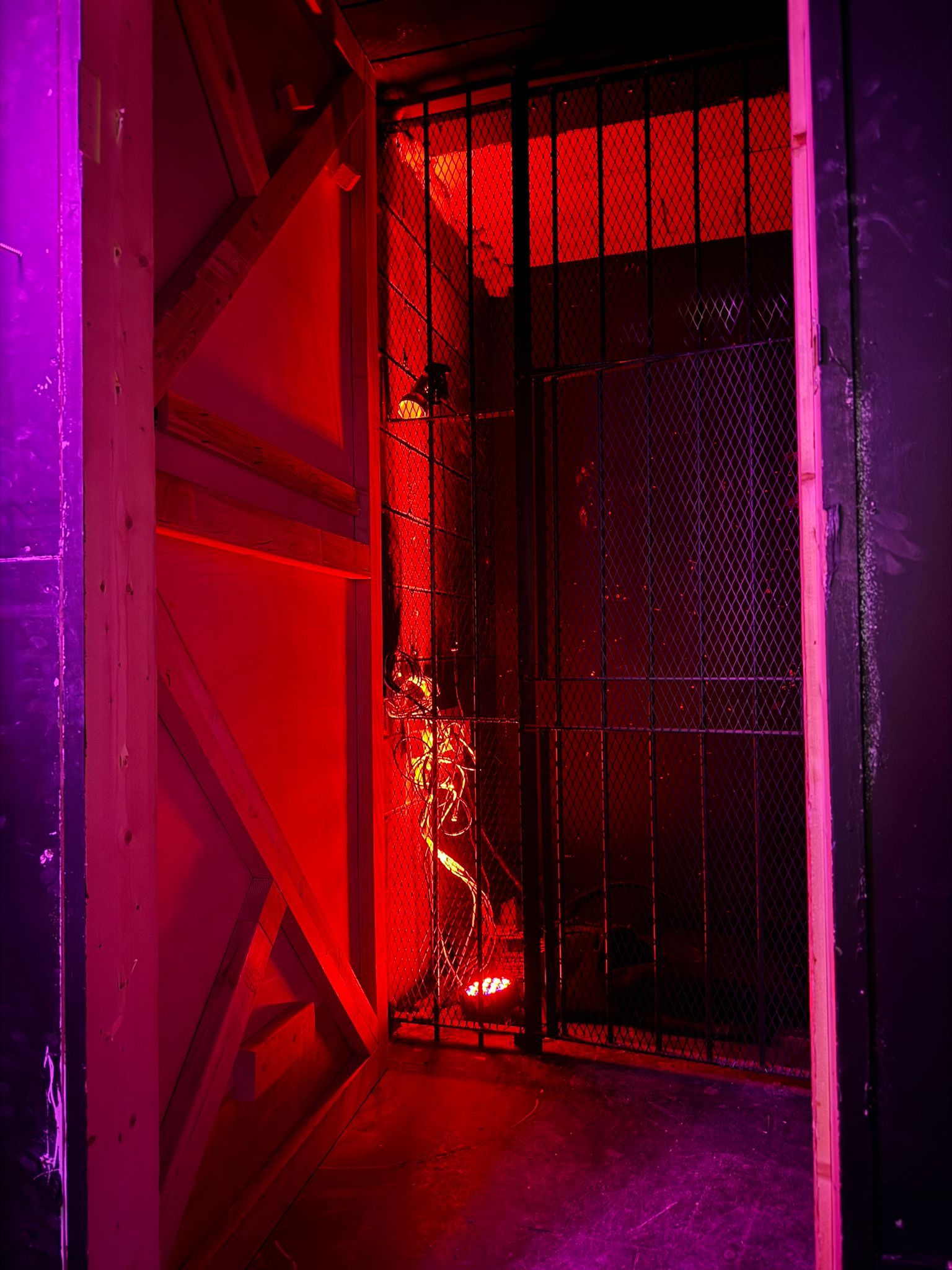
4. Metal cage partition
The metal cage is one of the fastest ways to add depth.
Shoot through it for foreground texture. Put your subject behind it for a more enclosed frame. Light the cage from the side and the mesh catches the colour while the background falls away.
Red and purple lighting push it towards a late-night, music-led look. Neutral light keeps it raw and architectural.

5. Industrial staircase
A staircase gives you levels, lines, and movement without moving a wall.
Use the steps for seated portraits. Shoot from below for a more imposing frame. Place the subject at the top and use the rails to pull the eye upwards.
The raw metal construction works for campaign stills, artist content, performance images, and short-form video. It is also useful when you need several poses from one tight area.
Change the angle. Keep the same backdrop. You have a new image.
6. Dark lounge corner with leather bench
Not every industrial frame needs to feel hard.
The dark lounge corner brings in leather, shadow, and a more intimate shape. Use the bench for seated portraits, paired talent, interview-style stills, or product shots that need a lifestyle setting.
Keep the room dark and let one coloured source skim across the leather. The material will hold the highlight. The background will disappear.
A good option for music artwork, fashion campaigns, and night-led brand content.
7. Red-lit corners
Red light changes a plain corner immediately.
Use it for close portraits, movement, and frames with a heavier mood. Red can flatten a space if it is everywhere, so keep some areas dark. Give the eye somewhere to rest.
Try a profile pose against the wall. Or place your subject at the edge of the light so half the face drops into shadow.
The result feels deliberate without needing props.
8. Purple-to-red studio lighting
Colour gives you multiple looks in one booking.
The lighting rig at @38 can move between purple, red, teal, and blue washes. Use purple for a cooler editorial frame. Push red into the background for contrast. Blend both across the same shot for a more atmospheric result.
This is useful when you need a campaign to feel connected but not repetitive.
Shoot the same styling under two colours. Change the direction of the subject. You have two distinct looks without changing location.
9. Blue-lit DJ booth
The DJ booth brings equipment into the image.
Pioneer CDJ decks, turntables, mixer, monitors, and the surrounding industrial structure give you an immediate music and nightlife context. You can shoot the DJ at work, create artist portraits, or use the equipment as graphic foreground detail.
It is also a strong backdrop for headphone, streetwear, drinks, and tech campaigns.

Keep the blue low and let small highlights from the equipment break through. The screens and controls will add detail without filling the frame with clutter.
10. A-frame podcast structure
The A-frame podcast setup gives you a clean focal point with industrial edges.
Use the structure to frame one person or two. Bring in the microphones for a working, documentary feel. Or remove attention from the equipment and use the geometry as a strong shape behind the subject.
This backdrop works for:
- Founder portraits
- Interview stills
- Podcast artwork
- Talking-head content
- Culture and media campaigns
You can book the main floor for the look, then move into the dedicated studio room if you also need controlled audio or video recording.

11. Raw wooden elements
Wood softens the metal and concrete around it.
Use the raw wooden beams, framing, and structural details for warmer images. They work well against red light, amber tones, and neutral daylight. The grain gives close-ups more texture. The structure gives wider frames a sense of place.
Mix wood with black clothing or reflective materials for contrast.
The point is not to make the set look polished. Keep the marks, joins, and uneven surfaces visible.
12. Dramatic window light
Natural light gives the space another direction.
Shoot when the window light is strongest, then use the darker areas of the room as negative space. Place your subject close to the light for a sharper portrait. Pull them back for a softer fall-off across the body.
You can also combine window light with the coloured rig. Let daylight shape the face while red, purple, or blue light sits in the background.
That contrast creates depth without extra set dressing.
13. Warehouse ceiling
Look up.
The ceiling gives you a wider sense of the building and makes smaller compositions feel more expansive. Use it for wide editorial frames, group portraits, performance stills, and campaign images where the location needs to be visible.
Exposed structure, cable runs, beams, and lighting tracks can all become part of the shot.
Shoot from below. Use a wide lens. Keep the subject small in the frame and let the architecture carry the image.
14. Bar area
The bar adds a different kind of context.
Use it for nightlife campaigns, drinks content, hospitality brands, artist portraits, and event photography. It gives you a natural place for your subject to stand, lean, sit, or interact with a prop.
Keep the styling minimal. One glass. One bottle. One strong light. The area already gives the image enough information.
For larger launches or branded nights, the full events space has a 170-person capacity, bar operation, DJ setup, security, and full-colour lighting rig.
15. Mixed metal and timber textures
The strongest frames often combine more than one surface.
Pair metal with timber. Concrete with brick. Dark leather with red light. Use the difference between hard and soft textures to create visual tension.
This approach is useful when one backdrop needs to support a full shoot day. You can keep the same overall industrial language while changing the frame through:
- Camera height
- Lens choice
- Lighting colour
- Subject position
- Styling
- Texture in the foreground
That is how you get more output without building more sets.
How to plan a shoot at an industrial photoshoot location in London
Bring the kit you need, but do not overpack the set.
Start with three planned looks:
- A raw daylight setup
- A coloured lighting setup
- A darker, close-up setup using leather, metal, or the DJ booth
Then build variations inside each one.
Change the subject’s position before changing the backdrop. Move from standing to seated. Shoot wide, mid, and close. Capture stills and short-form video while the lighting is already set.
The main floor has power throughout, track lighting for your own kit, parking by arrangement for equipment vans, and a studio room for talent or changing. Access is available from 08:00, Monday to Sunday. Your booking is exclusive.
You can also use both spaces through a content day booking, switching between the raw industrial main floor and the cleaner studio room on the same day.
Book the backdrop. Not the build.
If you need a photography studio Hackney can offer without the blank-box problem, @38 gives you the surfaces, structure, and lighting to start shooting straight away.
Main floor shoot hire: from £600 for a half day : up to 4 hours.
Location: Clapton E5.
Full-day hire: £1,100 for up to 8 hours.
Visit at38.org to check the space, or book a shoot day. We respond within 24 hours.
Which backdrop would you shoot first : the cage, the staircase, the DJ booth, or the red-lit lounge? Comment below and tell us. Then DM us or book at at38.org.
Leave a Reply