A fake industrial set can look convincing on camera. It can also consume your budget before the first shot.
You pay for the design. Then the materials. Then the set builders, transport, installation, lighting changes, safety checks and breakdown. By the time the room looks “raw”, you may have spent hours recreating what already exists in a real warehouse.
If you’re looking for an industrial photoshoot location in London, the better option is often simpler:
Book the space. Bring the kit. Shoot.
At @38, the architecture is already doing the work. Exposed brick. Steel beams. Concrete floors. Dark corners. High-contrast lighting. No set build required.
The set is already there
Industrial texture is difficult to fake because real materials carry history.
A printed backdrop can suggest brick. A painted flat can suggest concrete. A lightweight scenic wall can suggest steel. But the camera sees the difference. So does the light.
Real brick catches a side light differently from a printed surface. Concrete absorbs and reflects light with its own uneven pattern. Steel beams create natural lines, depth and scale. These details give a frame weight without needing layers of artificial dressing.
That’s the advantage of a raw industrial venue. You are not starting with an empty room and trying to manufacture character. You are starting with character and deciding how much of it to reveal.
At @38, the exposed surfaces are part of the space. They are not props brought in for one campaign and removed before lunch.
What building a set really involves
“Let’s just build a wall” sounds manageable until the production list grows.
A temporary set may require:
- Concept development and technical drawings
- Materials, scenic paint and finishing
- Carpenters, fabricators or welders
- Transport to the venue
- Installation and lighting access
- Health and safety checks
- Storage between shooting days
- Dismantling and removal
The physical wall is only one line on the budget. The rest is labour, logistics and time.
Industry guidance on on-location sets versus studio sets makes the same distinction: a built studio set offers control, but construction and dressing add cost. A real location can provide authenticity, scale and texture without recreating the environment from scratch.
The money you save on construction can go where it is visible: your talent, lighting, camera, styling, sound or post-production.
Your schedule matters more than the moodboard
A set build does not start when the camera arrives.
It starts during the design phase. Then comes sourcing. Then fabrication. Then delivery. Then the build window. If anything arrives late, is damaged in transit or does not fit the room, the shoot schedule takes the hit.
That is a lot of moving parts for a single backdrop.
A ready-made industrial location compresses the process. You scout the space, plan your shots, confirm access and arrive with your team. There may still be lighting and styling to organise. That is production. It is different from constructing the room around the production.
This matters when you are working with:
- A small crew
- A fixed talent schedule
- A product launch deadline
- Multiple deliverables
- A limited daylight window
- A campaign that needs stills and video on the same day
Less construction means more time to shoot.

Real surfaces give you more than one look
A good location should not lock you into one frame.
The point is not to find one perfect wall and photograph it repeatedly. The point is to use the space as a system of surfaces, lines, shadows and changing light.
At @38, you can build different visual directions within one booking:
The hard look
Use the exposed brick, steel structure and concrete floors. Keep the styling restrained. Let the geometry create a harder, stripped-back frame for fashion, music or product work.
The low-key look
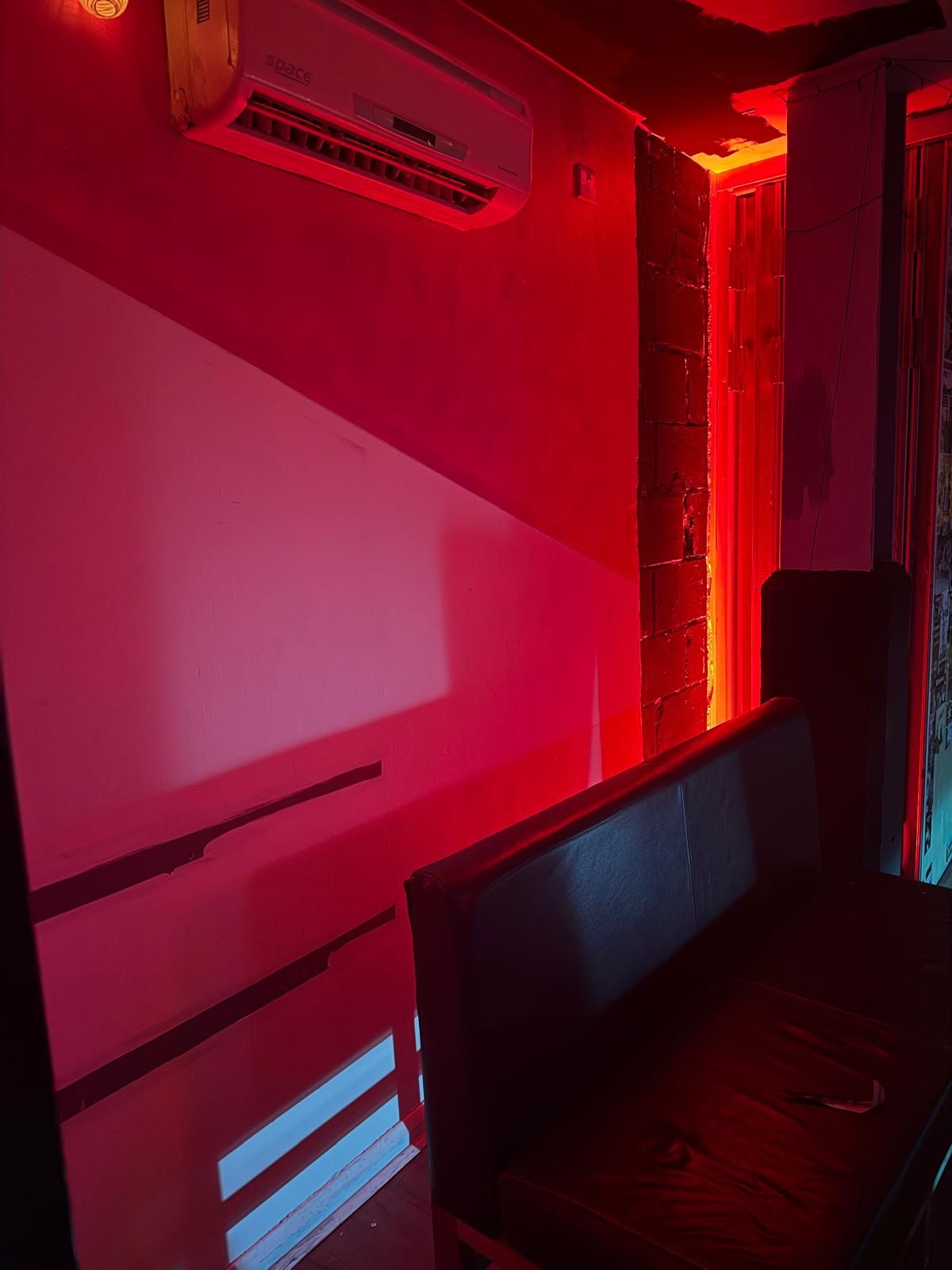
Push the background into darkness. Use a tight source on the subject and let colour fall across the architecture. Deep indigo, magenta, cyan and amber work against the industrial surfaces without covering them.
The human look
Move into a darker lounge or seating area. Add a subject, a chair, a leather bench or a small amount of styling. The space becomes more intimate without losing its edge.
The wide look
Step back. Use the height, beams and floor lines to create scale. A real industrial venue gives you depth that a small fabricated set often cannot.
One booking can give you several visual directions. No wall reset. No scenic repaint. No crew waiting for a new flat to be installed.
A raw space gives the lighting somewhere to go
Flat light makes a set look flat.
Industrial environments give lighting something to catch. Rake a light across brick and the texture becomes visible. Push colour into a steel structure and the lines recede into the frame. Let a concrete floor fall into shadow and the subject gains separation.
This is where real materials beat imitation.
A white studio can be useful when you need total control. But if your concept depends on atmosphere, a neutral room creates more work. You have to bring in the texture, create the depth and control the background.
At @38, you can start with a darker base and shape it around the subject.
The same principle applies to video. Dark surfaces reduce visual distraction. Practical lighting and controlled colour can create movement without filling the frame with set dressing. Your camera sees a space with depth rather than a wall pretending to be one.
For more practical guidance, read our industrial photoshoot mistakes guide, including why over-lighting can remove the very atmosphere you came to capture.
The budget is not only the venue hire
Venue hire is easy to compare. Total production cost is harder.
A cheap room can become expensive when you add:
- Scenic construction
- Additional crew
- Delivery and collection
- Furniture and dressing
- Extended access for installation
- Lighting to hide the room
- Time lost between setups
- Disposal or storage after the shoot
A raw industrial venue can remove several of those line items at once.
At @38, shoot bookings start from £175. Commercial and larger styled productions start from £600, depending on the brief and requirements. You get full exclusivity, so there are no other bookings moving through the frame while you work.
The exact rate depends on the scale of your shoot. The principle stays the same: use the money on the image, not on pretending the room has a past.

When a set build still makes sense
A real location is not the answer to every production.
Build a set when you need complete control over:
- A fictional environment
- A repeatable modular layout
- Moving walls or practical effects
- A highly specific brand world
- Several days of continuous access
- A set that will be reused across multiple campaigns
If the build will be used repeatedly, the cost may make sense. If the room has to behave in a very specific way, a custom environment may be necessary.
But for a single campaign, portrait session, lookbook, music video, interview or content day, ask the basic question first:
Do you need to build the texture, or can you book it?
Why East London works for this kind of production
The right location should be practical as well as visual.
@38 is in Clapton · Hackney · London E5. It is a creative space in East London built for shoots, recordings, events and content production. The venue gives you a dark industrial base without requiring a full set build before your team can work.
Use the exposed brick. Frame the steel beams. Let the concrete floor hold the shadow. Bring the camera closer. Change the light. Keep moving.
For larger productions and brand events, the space also has a 170-person capacity. For audio-led work, the venue supports studio recording, podcast sessions and DJ bookings. One location can support more than one type of content, which matters when a campaign needs interviews, stills, reels and live material in the same production window.
Final cut
Fake sets are not always bad. They are just rarely free.
If your concept needs an artificial world, build one properly. If your concept needs brick, steel, concrete, shadow and atmosphere, start with the real thing.
A raw industrial venue gives you:
- Instant production value
- Real texture under real light
- More visual options within one booking
- Less construction and breakdown
- A stronger sense of place
- No set build required
Book the room. Spend the budget where the audience will see it.
Planning an industrial shoot in London? DM @38 to check your date. We respond within 24 hours.
And comment below: what was your worst set-building nightmare? A late delivery, a wall that would not fit, a last-minute repaint, or a budget that disappeared before the shoot started? Tell us what happened.
Leave a Reply