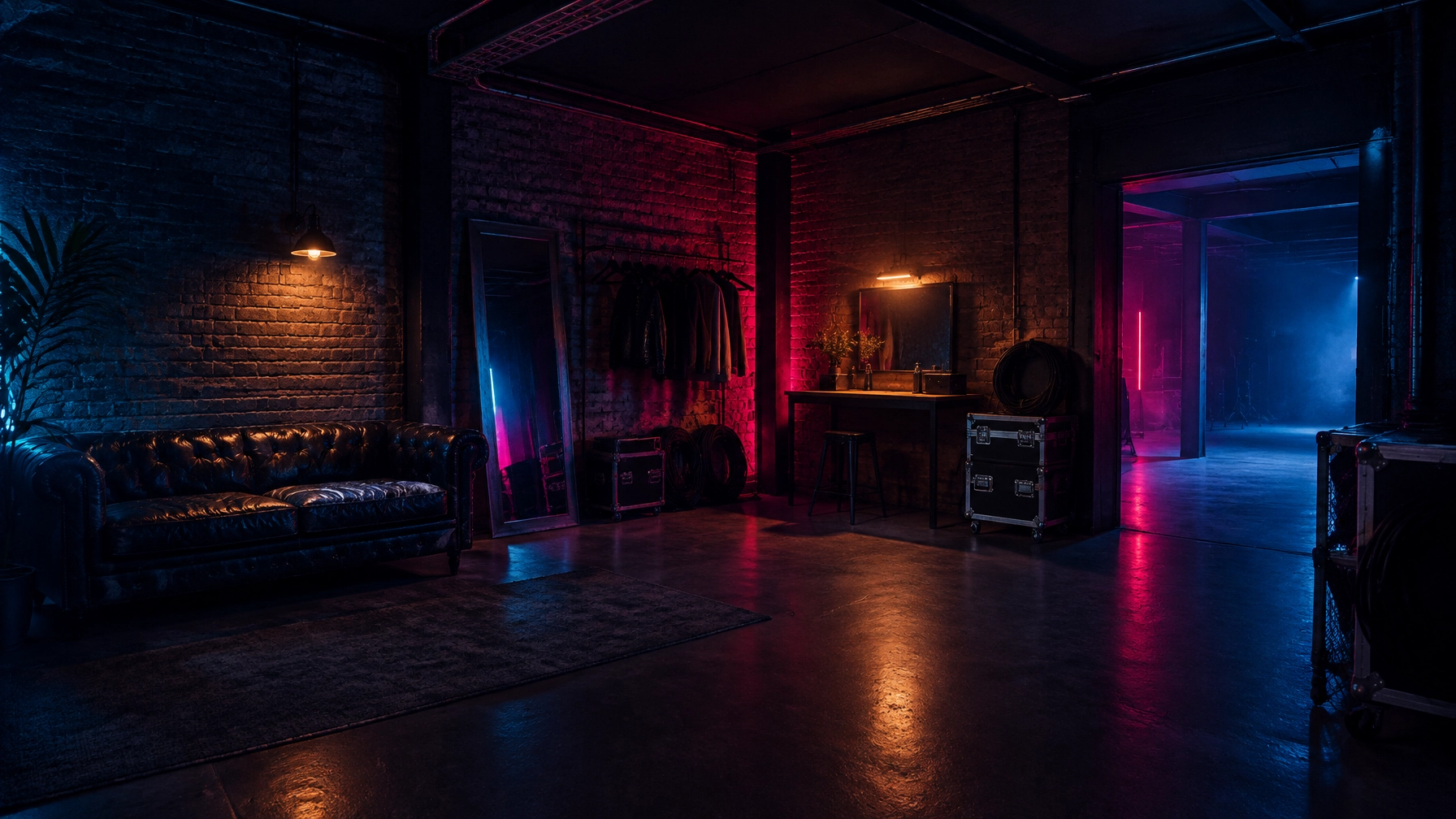
The set gets the attention.
The lighting. The camera package. The backdrop. The first frame.
But a shoot rarely runs smoothly on the set alone. People need somewhere to wait, change, prep, recharge and keep their kit out of the way.
That room is the green room.
For film shoots, photo shoots, interviews and content days, it is not an optional extra. It is part of the production infrastructure.
A good green room keeps the main floor clear. It gives talent privacy. It gives the crew a place to organise wardrobe and equipment between setups.
It also gives everyone five quiet minutes when the day starts moving too fast.
A green room is production space
A green room should do more than hold a sofa.
It needs to support the work happening around the camera.
Talent may use it to:
- Arrive and settle before filming
- Change between looks
- Wait between takes
- Review a script or call sheet
- Take a break from the main floor
- Prepare for hair and makeup
- Store personal items
- Keep wardrobe and props organised
- Charge phones, laptops and styling tools
Without a dedicated room, all of that ends up happening beside the camera.
Bags collect near the lighting stands. Coats land on flight cases. Talent changes behind a temporary screen. A stylist works from the edge of the set. Someone asks where the spare batteries are.
None of these problems are dramatic on their own.
Together, they slow the day down.
A green room creates separation. Main floor for the work. Studio room for everything that keeps the work moving.

What a good green room should have
When you book a studio, ask about the second room before you ask about the wall colour.
The details matter.
1. Seating that works for the whole group
One chair in a corner is not a green room.
You need enough seating for the expected talent, client representatives and crew who may be waiting between setups. A sofa, lounge chairs or a simple combination of both gives people somewhere to reset without taking over the active floor.
Look for seating that is comfortable but practical. Dark upholstery is useful on production days. It hides the marks that come with real work and does not compete with wardrobe or makeup.
The room should also have a surface for phones, scripts, water and personal items.
2. Mirrors and a proper prep area
If talent is changing, the room needs a mirror.
Ideally, it should be a full-length mirror with enough light to check wardrobe properly. A smaller mirror and counter are useful for hair, makeup and quick touch-ups.
Ask where the styling team will work.
They need somewhere to put brushes, products, hair tools and kit bags. They need power close to the counter. They need a layout that does not force cables across the main walkway.
A mirror on the wall is not the same as a usable prep station.
3. Power where people actually need it
Hair dryers, straighteners, steamers, chargers and small lights all need power.
A good green room should have accessible sockets around the seating and prep areas. Production teams should not need to run one long extension lead across the room to reach a single outlet.
Before the shoot, check what the space provides:
- Number and location of sockets
- Extension leads or power strips
- Power capacity for styling tools
- Space to charge phones and laptops
- Cable management around the prep area
Small details. Big difference during an eight-hour booking.
4. Hooks, rails and storage
Wardrobe needs a home.
Hooks near the door help keep coats and bags off the floor. A clothing rail gives talent and stylists somewhere to organise different looks. Shelving or storage cases keep accessories, props and personal items in one place.
The aim is simple: keep the room usable.
A pile of clothes on a sofa is not a wardrobe system. A set of cases blocking the door is not storage.
Use zones. Personal items in one area. Wardrobe in another. Props and production equipment where they can be found quickly.
Labelled storage is useful too, even if the labels are temporary.
5. Privacy and a door that closes
The green room should feel separate from the set.
That means a door that closes properly. It means talent can change without working around crew traffic. It means someone can take a private call or have a quiet moment between takes.
A separate entrance is useful where available. It allows talent and clients to move in and out without crossing an active shooting area.
If the room has an internal connection to the main studio, check how the two spaces flow together. You want easy access without constant noise and interruption.
A practical test is simple. Close the door. Stand inside. Listen.
Can you hear every conversation on the main floor? Can the main floor hear the green room? If the answer is yes, the room may work for holding and changing, but less well for a proper quiet reset.
6. Temperature and ventilation
People notice temperature quickly.
A room full of wardrobe, lighting kit, hair tools and several people can become uncomfortable fast. A cold room is no better.
Ask how temperature is managed. Check for ventilation, heating and fans. Make sure the green room is not treated as an afterthought because it is smaller than the main floor.
The right temperature helps talent stay comfortable and helps makeup, wardrobe and hair teams work properly.
7. Wi-Fi and mobile signal
A green room is often where production admin happens.
Call sheets. Scripts. Reference images. Client messages. Location notes. Music playback. Last-minute approvals.
Reliable Wi-Fi matters.
Check the network before the shoot. Confirm the password. Test mobile reception in the room. If the studio is in a basement or heavily enclosed building, signal can be weaker than expected.
It is also worth having enough charging points for the people who will spend time there.
8. Water, refreshments and a clear food policy
People waiting between takes need water.
A small refreshments setup can include bottled water, a drinks station, tea and coffee, or a simple table for catering. The important part is knowing what is allowed and where food can go.
Ask about:
- Drinking water
- Fridge access
- Catering drop-off
- Food and drink near wardrobe
- Waste and recycling
- Cleaning after the booking
This is especially important on longer shoots. Up to eight hours is a long time to rely on one vending machine and a crowded main floor.

The green room should reduce movement
The best green rooms save time because they reduce unnecessary movement.
Talent does not need to cross the set to change. The stylist does not need to carry every garment back and forth. The client can review a look without standing beside the camera. Bags and coats stay away from the frame.
That is the real value.
You are not paying for a decorative lounge. You are paying for a space that lets the production work in parallel.
At @38, you get two connected spaces: the main floor and a studio room. Depending on the booking, the second room can support talent holding, changing, prep, quiet breaks and gear storage between setups.
The spaces are booked exclusively. No other production is sharing the floor or moving through your green room while you work.
That matters on a film shoot. It matters on a photo shoot. It matters whenever the day involves multiple looks, several contributors or a client who needs somewhere to work.
A green room should match the shoot
Different productions need different support.
For a portrait shoot, the priority may be a mirror, wardrobe rail and space for styling.
For an interview, it may be quiet holding, refreshments and a private place for contributors to prepare.
For a music video, it may be changing space, props, bags and several wardrobe changes across the day.
For a branded content day, it may need to support talent, client teams, product samples and laptops at the same time.
Tell the venue what you are bringing. Give them the number of people, the number of looks and the type of equipment involved.
A useful booking brief includes:
- Shoot type
- Number of talent
- Crew size
- Number of wardrobe changes
- Hair and makeup requirements
- Storage needs
- Catering or refreshments
- Required booking length
- Any privacy or access requirements
This gives the venue something concrete to work with.
It also gives you a better chance of finding out what is included before the booking is confirmed.

Why this matters at @38
@38 is a creative space East London productions can use without building a set from scratch.
The raw industrial surfaces are already there. Exposed brick. Dark steel. Concrete. Shadow. Practical areas that can shift between photo, film, interview and content work.
The main floor gives you the visual environment.
The connected studio room gives the production somewhere to function around it.
Located in Clapton · Hackney · London E5, @38 is available for shoot bookings from £175 for up to 4 hours, with bookings of up to 8 hours available. You get full exclusivity for your booking.
No other crew on the floor. No shared green room. No need to work around another production.
See the shoot space or book a shoot.
We respond within 24 hours.
Ask about the room, not just the backdrop
The backdrop gets you interested in a studio.
The support space helps you finish the day on time.
Before you book, ask:
- Where does talent wait?
- Where can people change?
- Is there a mirror and prep surface?
- How many power outlets are available?
- Is there storage for wardrobe and gear?
- Can the door close?
- Is the room quiet?
- Does the green room have the same access hours as the main floor?
- Is it private and exclusive to your booking?
- Where can refreshments and catering go?
A strong visual space gets the shot.
A functional green room helps you get the shot without the day becoming messy.
What do you need from a green room? Seating, wardrobe rails, better lighting, a quiet door, more power, somewhere to store kit?
Tell us in the comments below.
For your next film shoot or photo shoot, DM @38 or book at at38.org.
Leave a Reply