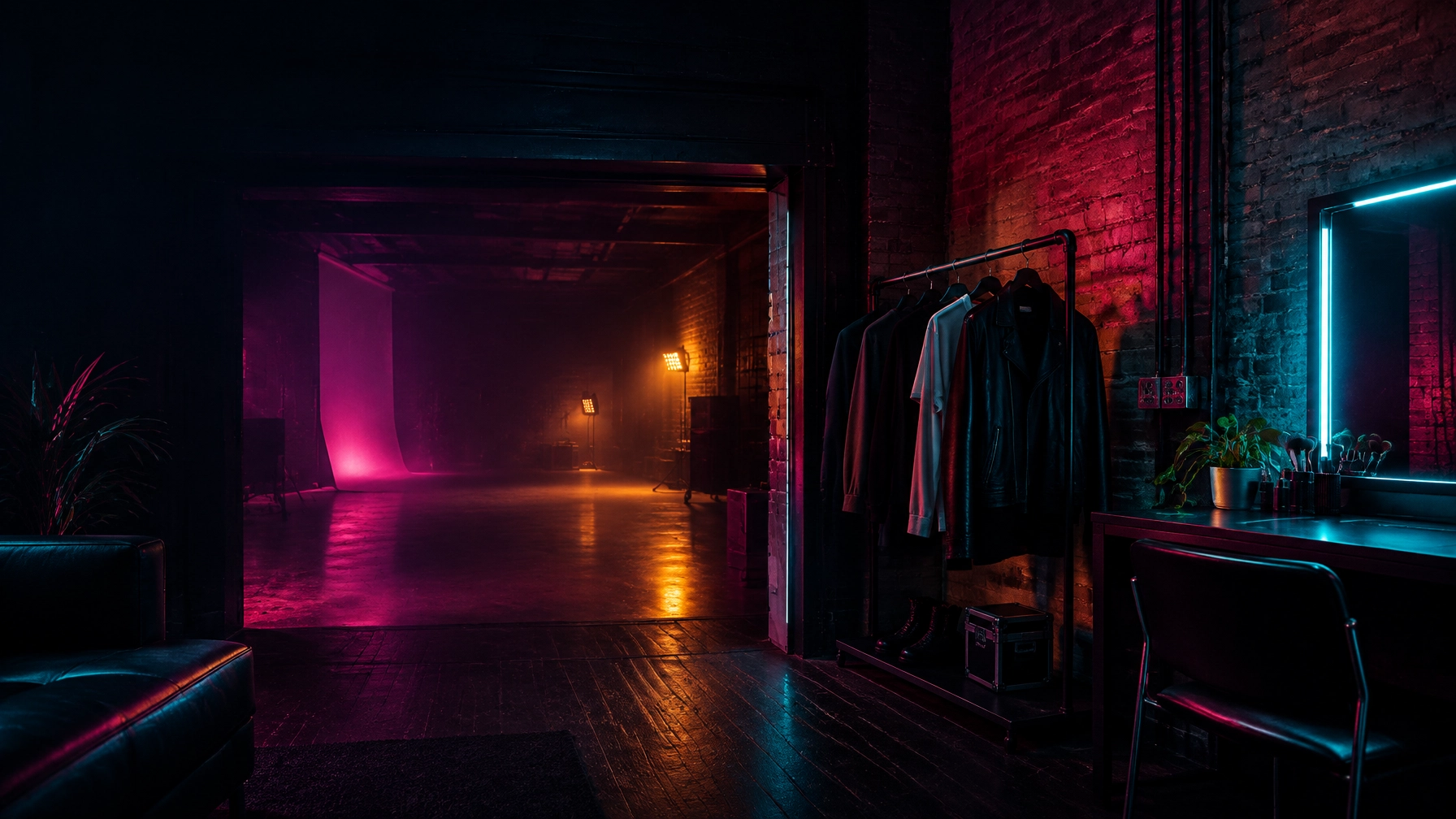
A good studio booking is decided before shoot day.
Not by the colour of the walls. Not by how polished the listing looks.
By the practical details.
Where does talent wait?
Where does the kit go?
Can someone change privately?
Can the crew move from green room to set without crossing a maze of corridors?
Run the green room test before you commit. It tells you whether the space has been built for a real production, or whether you’ll spend the first hour solving problems that should not exist.
If you’re looking for a photography studio in Hackney or a flexible creative space in East London, use this checklist.
1. Is there a separate space for talent and kit?
A green room should not be a chair pushed into the corner of the main floor.
You need somewhere separate from the camera, lights, cases and crew traffic.
Check for:
- A dedicated room or connected secondary space.
- Enough room for talent, makeup, styling and personal belongings.
- A clear place for garment rails and hanging clothes.
- Storage for cases, bags and production kit.
- A layout that keeps the main floor clear.
This matters on every shoot. It matters more when you have multiple looks, several contributors or a client watching from the side.
Talent should not be changing beside a flight case.
Wardrobe should not be piled under a lighting stand.
Your green room should reduce movement, not create more of it.
At @38, the main floor connects to a separate studio room for talent and changing. The two spaces can support a simple flow: prepare away from the set, then move straight onto it.

2. Can the venue explain load-in in one message?
Before you book, ask one basic question:
How do we get the kit from the van to the floor?
You want a direct answer. Not “it should be fine.”
Confirm:
- Where you unload.
- Whether the space is ground-level or reached by stairs.
- How far the entrance is from the shooting area.
- Whether equipment vans can park nearby.
- What time you can arrive for setup.
- Who will meet you.
A smooth load-in protects your booking time. If your hire is four hours, losing 30 minutes to unclear access is not a small issue.
The best studios give you a simple route. Entrance. Equipment in. Cases stored. Lights up. Shoot starts.
@38 is in Clapton · Hackney · London E5. Parking is available by arrangement for equipment vans, and access starts from 08:00, Monday to Sunday. Confirm your exact arrival plan before the day.
3. Is there somewhere to hang, store and reset?
A good green room is part of the production workflow.
It gives your team a place to:
- Hang wardrobe.
- Store personal bags.
- Prepare the next look.
- Keep finished outfits away from the floor.
- Take five minutes between setups.
- Reset without being watched by the whole crew.
That last point is easy to underestimate.
Photo and film shoots are repetitive. Change position. Adjust lighting. Check playback. Change wardrobe. Repeat.
A separate reset space keeps the main floor moving while talent and styling prepare the next stage. It also gives the client somewhere to step away from the camera without leaving the venue.
Ask what is already available. Then ask what you need to bring.
Do not assume a studio includes rails, hangers, tables, mirrors or steaming equipment unless the venue confirms it. A clear answer is part of the green room test.
4. Is it quiet enough to use?
A green room needs to be close to the set.
It also needs to feel separate from it.
Look for a room where talent can wait, change or review the next setup without sitting inside the noise of the production. That separation helps when you are filming interviews, working with children, managing a large cast or shooting a campaign with several outfit changes.
Ask:
- Is the green room separated from the main floor?
- Can people hear the shoot clearly?
- Is there a door or clear boundary?
- Can the client wait somewhere away from the camera?
- Does the room stay private during the booking?
The aim is not silence for its own sake. The aim is control.
Your main floor can stay active. Your talent can stay focused. The crew can reset without turning every pause into a full stop.
At @38, the studio room is independent from the main floor and designed as a controlled environment. For audio and video work, that separation also helps reduce bleed and unwanted background noise. Explore the dedicated studio room.

5. Can you reach power without running cables across the set?
Power is a small detail until it becomes a problem.
Check where the sockets are before you arrive. Consider the position of:
- Lighting equipment.
- Hair and makeup tools.
- Monitors.
- Chargers.
- Audio equipment.
- Styling equipment.
- Any practical lights or props.
Power should be accessible in both the shooting area and the green room. Cables should not create a trip hazard between the changing space and the set.
If you are bringing high-draw equipment, ask about the available supply and any restrictions. Do not leave it until load-in.
@38 has power throughout the main floor, with track lighting available for your own kit. The space is built to be used as a working production environment, not just photographed as a backdrop.
That distinction matters.
6. Can talent change privately?
Privacy is not an upgrade. It is a basic production requirement.
Make sure the green room is actually private. Not a shared hallway. Not a screened-off corner beside the camera. Not a room that the venue plans to use for storage during your booking.
Ask:
- Can talent change inside the room?
- Is the space fully exclusive to your booking?
- Can clothing and personal items stay there?
- Can the room remain closed when needed?
- Is the route to the set straightforward?
A private space gives talent a better experience and gives your crew a cleaner workflow. It also removes an avoidable layer of awkwardness from the day.
At @38, bookings are fully exclusive. No other production is sharing the floor while you shoot.

7. Can someone describe the layout without sending a novel?
This is the simplest test.
Ask the venue to explain the space in one message.
You should be able to understand:
- Where you arrive.
- Where you load in.
- Where the main floor is.
- Where talent changes.
- Where kit can be stored.
- Where power is available.
- Who to contact on the day.
If the answer is vague, the booking may be vague too.
A clear layout usually means the venue team understands how productions work. It also lets you brief your photographer, director, stylist, client and crew before anyone arrives.
At @38, the setup is simple: a raw industrial main floor, a connected studio room, dark wood, exposed brick, dramatic colour lighting, track lighting and power throughout. Two spaces. One booking. No set build required.
The @38 green room test
Here is the short version to save before you book a studio:
- Separate space for talent and kit.
- Clear load-in instructions.
- Storage and hanging space.
- Quiet area away from the main floor.
- Easy power access.
- Somewhere to reset between setups.
- Privacy for changes.
- A layout the venue can explain in one message.
- Full exclusivity during the booking.
- A clear start time, end time and rate.
At @38, shoot hire starts from £600 for up to 4 hours on the main floor. Full-day hire is available for up to 8 hours. If you need the separate studio room, rates start from £175 for up to 4 hours, with up to 8 hours available.
Use the shoot booking page to check your date and format. Site visits are available. We respond within 24 hours.

The green room is part of the set
The main floor gets the attention.
It is where the camera goes. Where the lighting lands. Where the final images are made.
But the green room decides how much time you get there.
A separate space keeps wardrobe moving. A clear load-in keeps setup on schedule. Private changing keeps talent comfortable. Accessible power keeps the floor safe. Full exclusivity keeps the production yours.
That is the test.
Before you book a photography studio in Hackney, ask what happens between the shots. Before you choose a creative space in East London, check whether the space supports the people making the work.
What is the green room detail you always check before booking a studio? Comment below.
For shoot dates, DM @38 or book at at38.org.
Leave a Reply