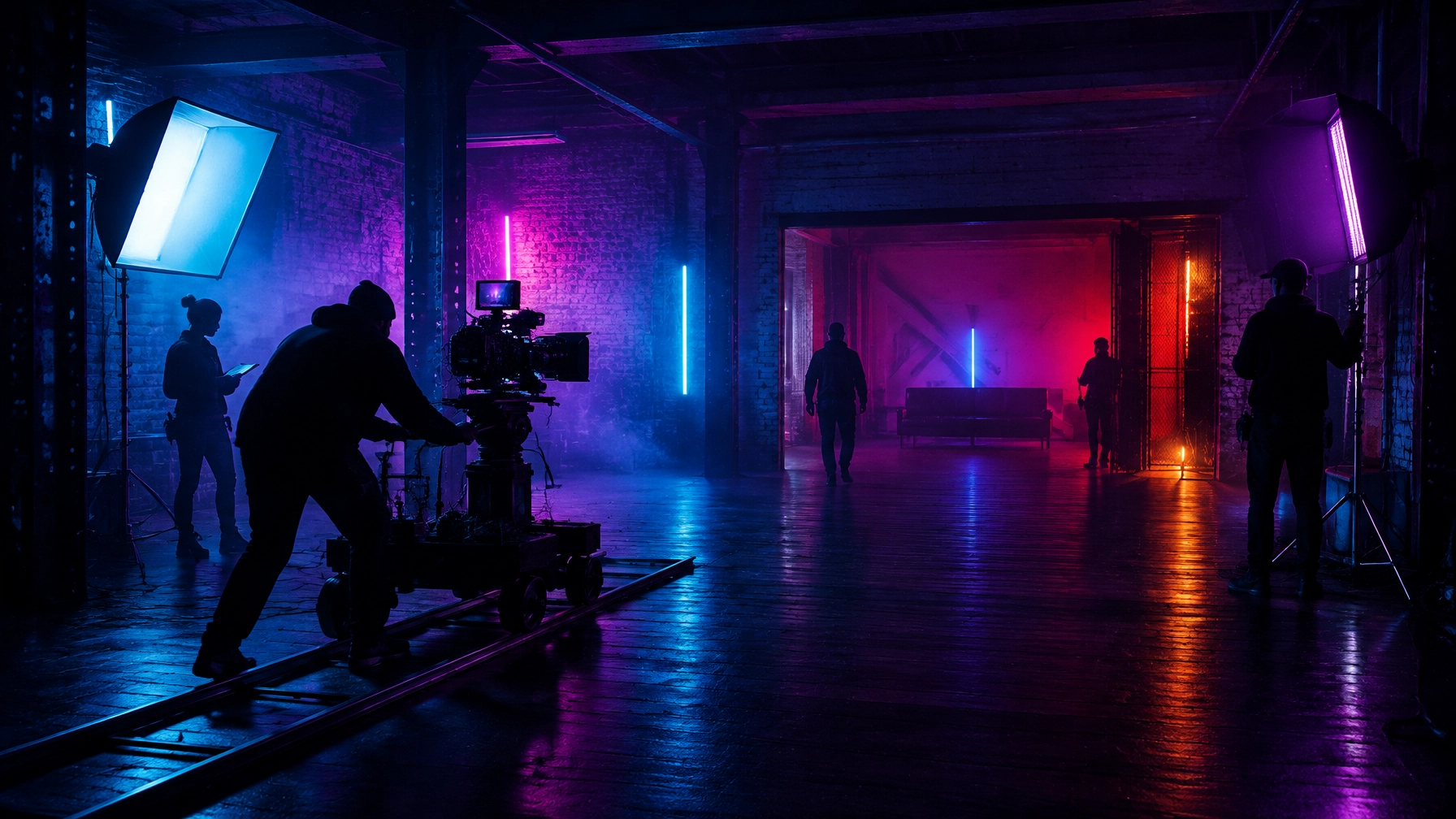
A warehouse can give your short film scale, texture and room to work.
It can also give you cable problems, poor sightlines and nowhere to put the cast if you choose badly.
The difference is in the layout.
At @38, you get 170-person capacity across two connected spaces. The main floor gives you the raw industrial frame: exposed brick, dark wood, metal structure and coloured lighting potential. The connected studio room gives you separation for talent, wardrobe, makeup, production or quiet holding.
One booking. Two working zones.
This is what that means on set.
A set that does not swallow the crew
A short film crew needs more than the area in front of the lens.
You need space behind the camera. Space for lighting. Space for art department. Space for video village. Space to move without walking through the shot.
A small studio can look fine on a recce and become unusable once the kit arrives.
The 170-person capacity at @38 is not a suggestion to fill the room with 170 people. It gives you headroom. A larger cast. A full crew. Clients. Production support. Equipment. All without compressing every department into the camera path.
The main floor can hold the shooting action while the connected studio room handles the overflow.
Use it as:
- Cast holding
- Green room
- Wardrobe and costume
- Hair and makeup
- Production office
- Video village
- Kit storage
- Quiet reset space
That separation matters. The performer should not be changing beside the lighting cases. The director should not be trying to brief the next setup over catering noise.
A two-space layout keeps the set moving.

Load in once. Keep the route clear.
Load-in is where a shoot can lose its first hour.
Cases arrive. Stands come out. Someone needs a clear path for the camera. Someone else needs to find a safe place for the lighting kit. Suddenly the entrance is blocked and every department is working around a pile of equipment.
Plan the route before the call sheet goes out.
At @38, parking is available by arrangement for equipment vans. Access starts from 08:00, Monday to Sunday. That gives you a practical early start for a short-film day, especially when the first setup involves a full lighting reset.
On your tech scout, map:
- Where camera and grip arrive.
- Where cases are staged.
- Where stands can be built without blocking movement.
- Where cast enter and wait.
- Where catering and crew breaks happen.
- Which routes must stay clear for fire exits and general access.
Keep the main floor usable. Do not turn your shooting area into a storage area.
The goal is simple: unload, stage, build and roll without moving the same case three times.
For broader production planning, The Location Guys’ warehouse guide makes the same point from a location perspective. Scale only helps when access and support space work with it.
Power is part of the lighting plan
A warehouse may look cinematic. That does not mean the electrical plan will take care of itself.
You still need to know what you are running, where it is running from and how the cables will cross the floor.
@38 has power throughout the shoot space, with multiple sockets available for professional equipment. That gives your gaffer a better starting point than a room with one convenient wall outlet and a long chain of extensions.
It does not remove the need for a proper distribution plan.
Before the shoot, confirm:
- The equipment list and expected draw.
- Which sockets will serve lighting.
- Where the camera and monitoring setup will run.
- Cable routes between zones.
- Where cable ramps or tape are needed.
- Whether any higher-draw equipment requires additional planning.
Keep high-draw fixtures separate from production desks and charging stations where possible. Mark trip hazards. Tape down temporary runs. Keep walkways visible.
The venue gives you the infrastructure. Your gaffer still owns the plan.

Controlled light without building a set
The strongest reason to choose an industrial location is often the light.
Not just how much light the room has. What the room gives you to work with.
@38 has a dramatic lighting rig with purple, red, teal and blue wash, plus track lighting for your own kit. That means you can build a visual language quickly. You can keep the room dark and controlled. You can use colour as a practical source. You can shape the frame with flags, negative fill and focused fixtures.
You do not arrive at an empty white box.
You arrive with a base layer.
For a short film, that can mean:
- One raw industrial look for the opening scene.
- A saturated colour shift for a performance or dream sequence.
- A darker corridor-style frame using the architecture and shadows.
- A separate studio setup for dialogue or inserts.
- Multiple angles without changing venue.
Use the existing structure as part of the composition. Brick gives you texture. Dark timber gives you depth. Metal gives you hard lines and visual breaks.
Then add only what the scene needs.
That is the difference between dressing a location and fighting one.
Sightlines give the director more options
A good warehouse location gives you distance.
Distance between the lens and the subject. Distance between the camera and the back wall. Distance for a longer lens. Distance for movement. Distance for the crew to work without appearing in frame.
Sightlines are especially useful for short films because one location often needs to play several parts.
You may need to shoot:
- A wide establishing frame.
- A close dialogue scene.
- A tracking shot.
- A group sequence.
- A performance setup.
- Cutaways and inserts.
The main floor at @38 is built for visual change without a full set rebuild. Shift the camera. Change the colour. Move the talent. Use the DJ booth, brickwork, dark surfaces or industrial structure as a new background.
The room does some of the production design before you arrive.

The green room is not an extra
A green room is production space.
It protects the pace of the day. It gives cast somewhere to wait. It gives wardrobe and makeup a defined base. It keeps performers away from noise and unnecessary foot traffic.
At @38, the studio room is available for talent and changing. It can also support interview, dialogue or clean-format video work because it is independent from the main floor and has controlled acoustics.
That gives you options.
Keep cast in the studio room while the main floor resets. Shoot a clean pickup or behind-the-scenes interview without changing location. Use the room for wardrobe and makeup, then move talent directly onto the main floor when the setup is ready.
If your short film includes multiple performers, plan the holding area early. Do not wait until the first person arrives.
Give the room a job:
- Cast holding
- Costume rail
- Makeup station
- Props table
- Quiet space
- Production notes
- Personal belongings
The main floor stays focused on the shot. The studio room keeps the people and kit organised.
No set build required
A set build can eat the budget before the camera rolls.
Materials. Labour. Delivery. Strike. Disposal. Time.
Sometimes you need one. Often, you need a location with enough character to carry the frame without one.
@38 is designed around that idea. The Shoots @38 space gives you dark industrial surfaces, raw brick, dark wood and coloured lighting potential. It reads on camera immediately.
For a short film, that lets you spend more of the day shooting.
You can still bring props, furniture, flags or small art elements. But you are not starting from a blank room. You are adding to an existing visual world.
That makes the space useful for:
- Narrative short films
- Music videos
- Fashion films
- Performance scenes
- Editorial video
- Product films
- Interviews and pickups
It is also why @38 works as a music video location in London. The architecture carries movement, colour and performance without demanding a full build.
What to confirm before you book
Before locking any video production studio in London, ask practical questions.
Confirm:
- How many people are coming?
- What is the load-in route?
- Where will vans park?
- What rooms can be used for holding?
- What power is available?
- How will cables run?
- What lighting is already in place?
- Can you bring additional fixtures?
- Which surfaces and areas are available on camera?
- What time can the crew access the building?
- Is the booking exclusive?
At @38, the booking is fully exclusive. No other bookings. Your crew, your kit and your shoot only.
Rates are clear:
- Studio room: up to 4 hours from £175
- Main floor shoot hire: up to 4 hours from £600
- Longer bookings: up to 8 hours
- Full main floor day: £1,100 for up to 8 hours
The space is at Clapton · Hackney · London E5.
For a combined shoot using both connected spaces, send the format, team size and date through the booking page. We respond within 24 hours.
Book the frame before you build the plan
A short film location should give you more than a background.
It should give you working room. A clear load-in. A place for cast to wait. Power where you need it. Light you can shape. Sightlines that open up the shot.
At @38, the 170-person capacity gives your production room to breathe across two connected spaces. The raw industrial main floor gives you the image. The studio room gives you the separation.
No white box. No set build required.
Book a shoot at at38.org, or DM @38 with your brief.
What is your biggest short-film location question: load-in, crew separation, lighting, green room or power? Comment below.
Leave a Reply