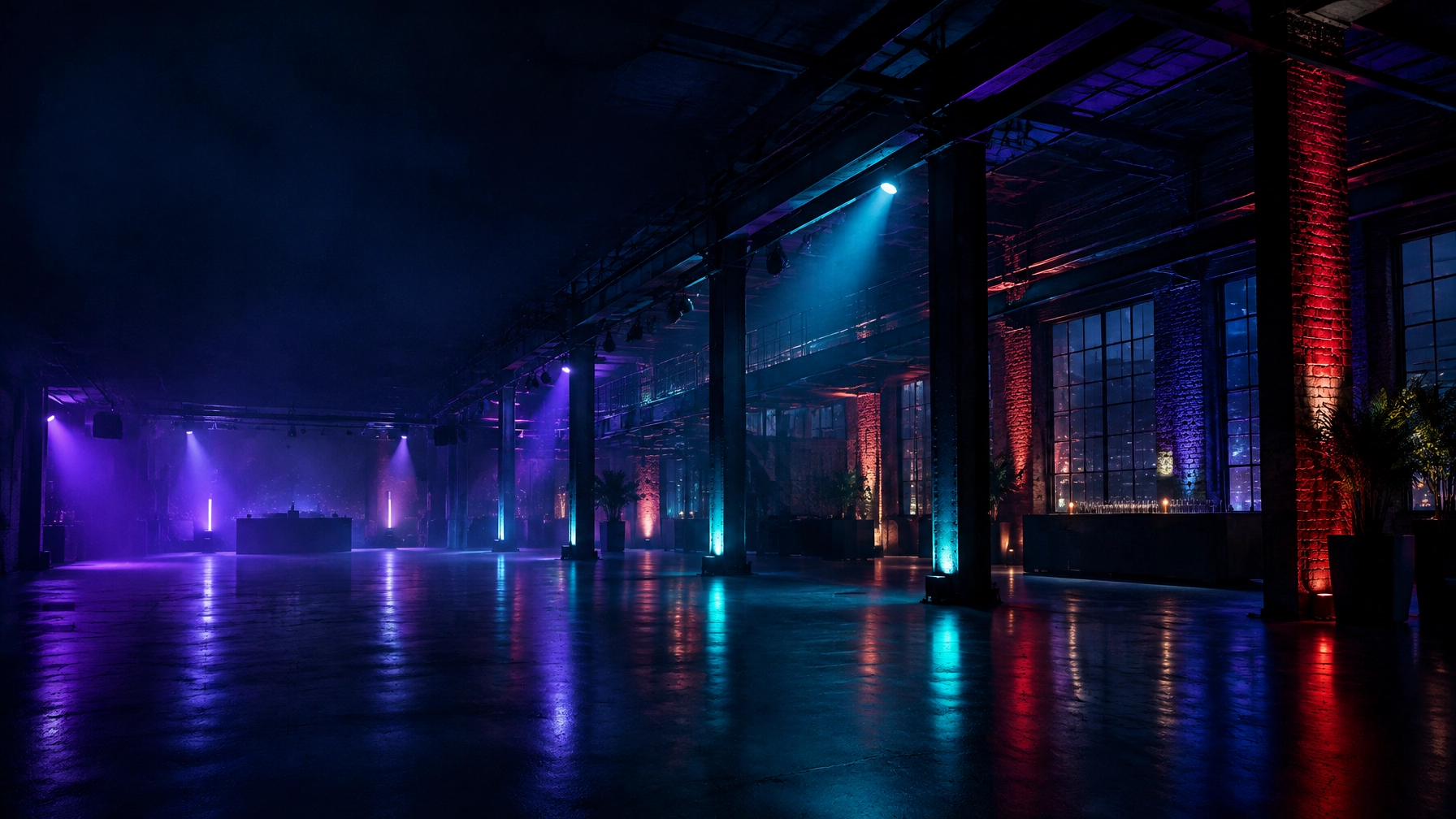
New Year’s Eve needs more than a room with tables, a bar and a clock on the wall.
It needs a setting with its own energy.
A raw industrial space gives you that from the start. Exposed brick. Dark timber. Steel. Concrete. Room for the lighting to work. Room for people to move.
At @38, you get a 170-person capacity venue in Clapton · Hackney · London E5, with full exclusivity, a staffed bar, security, DJ equipment and two connected spaces. Evening and weekend packages start from £2,500.
If you are looking for a warehouse event space in London or an industrial event space in London for New Year’s Eve, October is the booking window. Dates start moving early. The concept, layout and production plan need time to come together.
Here is how to build a night that keeps people in the room.
Start with the room, not the decorations
A hotel function room gives you a finished template.
Usually, that means carpet, banquet tables, neutral walls and a layout designed for predictable events. It can work. It can also feel like every other New Year’s Eve.
A raw industrial venue gives you more control.
You can build the night around the structure already there. Use the brick as a backdrop. Let the steel frame catch colour. Keep the floor open for dancing. Use furniture to create smaller zones without closing the room down.
The room does not need to look finished before you arrive. It needs to give you something to work with.
That is the difference.
At @38 Shoots, the main floor includes raw brick, dark wood, industrial textures and a dramatic purple, red, teal and blue lighting rig. No set build required. The space already reads on camera and in the room.
For New Year’s Eve, that matters. Guests should feel the atmosphere as soon as they walk through the door.
Plan the countdown as the main event
Midnight should not arrive by accident.
Build towards it from the moment doors open.
A simple structure works:
- Arrival: lower-energy music, clear lighting, bar service and content capture.
- Build: stronger DJ sets, deeper colour and more movement across the room.
- Final 15 minutes: simplify the lighting and focus attention on the DJ booth or countdown point.
- Midnight: one clear audio, lighting and visual cue.
- After midnight: change the look and move straight into the next track.
The countdown does not need to be complicated. It needs to be coordinated.
The DJ, lighting operator, host, bar team and security should all know what happens at 23:50, 23:59 and 00:00. If you are using a projection, LED screen, confetti or haze, test the cue before guests arrive.
The best countdown moments feel like part of the night. Not a pause in it.

Use lighting to change the room
The room can look different at 20:00 and 00:05 without moving a wall.
Start with a restrained look. Deep blue or teal across the industrial surfaces. A little amber around the bar. Enough light for people to arrive, find friends and order a drink.
As the night moves on, bring in purple and red. Increase movement around the DJ booth. Let colour draw guests towards the dancefloor.
At midnight, change the entire balance.
A brighter colour shift. A full-room wash. A clean burst of light. Then settle into a new look for the first track of the year.
Avoid lighting every corner evenly. Darkness creates depth. It also makes the brighter moments land harder.
If you are capturing video, speak to the lighting operator before the event. Constant strobes, total blackouts and fast colour changes can make footage difficult to use. Plan a few camera-friendly cues around the important moments.
The right lighting does two jobs:
- It makes the room feel larger and more atmospheric.
- It gives guests something worth recording.
Sound needs to carry the night
A New Year’s Eve party is only as strong as its sound.
The DJ setup at @38 includes Pioneer CDJ decks, turntables and a professional mixer, with a full PA and monitor system. That gives the DJ a familiar setup and gives the room enough structure for a serious night of music.
The programming should still have shape.
Do not start at full volume. Let the first set create room for conversation. Move into higher-energy tracks as the dancefloor fills. Save the biggest transition for midnight rather than using every peak too early.
Make sure the DJ has:
- A confirmed running order.
- The midnight track or sequence ready.
- A backup USB.
- A clear signal for the final countdown.
- Enough monitor volume to work without pushing the main system too hard.
If you are adding a host or live performer, build the changeovers into the schedule. A silent gap at 23:58 will be remembered for the wrong reason.
Make the bar part of the flow
The bar should be easy to find but not positioned where it blocks the room.
Keep the main route clear between the entrance, bar, dancefloor and second space. Use the bar as an anchor along one side of the venue rather than creating a barrier through the centre.
For New Year’s Eve, speed matters.
Keep the menu focused:
- Beer and cider.
- Wine.
- Spirits and mixers.
- A short cocktail list.
- Sparkling wine or prosecco for midnight.
- Water where people can reach it without joining the main queue.
Pre-batched serves can help. So can a dedicated midnight drinks plan. If every guest orders a complicated cocktail at 23:59, the bar becomes the bottleneck.
A staffed bar keeps the service moving. Security gives the room another layer of control. Both teams should receive a clear briefing before doors open, including the countdown window, guest numbers, emergency routes and any areas that need extra attention.
The operational details are not separate from the atmosphere. They protect it.

Give guests somewhere else to go
A 170-person room still needs different speeds.
Some guests will stay on the dancefloor all night. Others will want to talk, take a call, cool down or reset without leaving the venue.
Use the second space as a quieter zone or green room. It can support:
- Guest holding.
- Artist or DJ preparation.
- Coat and bag overflow.
- A calmer seating area.
- A separate content setup.
- A place for guests who need a break from the main room.
At @38, the studio room is independent from the main floor. For an event, that separation gives you a useful second environment without booking another location.
Think about the guest journey as a loop:
Entrance → bar → main room → second space → content moment → main room.
Avoid dead ends. Keep doors and routes visible. Make sure the second space feels intentional rather than like somewhere guests have accidentally wandered into.
You do not need to fill every corner with furniture. A few deliberate choices work better: a low-lit seating area, a clean route to the toilets, a well-positioned photo or video point and enough space around the bar.

Build content moments into the night
New Year’s Eve creates its own content.
The countdown. The first dance of the year. The room at full capacity. The DJ booth. The bar at midnight. Guests reacting to the lighting shift.
You do not need to cover the venue in branding to capture useful material.
Set up one or two clear content points. Use the architecture as the background. Keep the lighting consistent. Make the route easy so guests can step in, capture something and move on.
For professional coverage, plan for:
- A wide shot of the main room.
- A close shot of the DJ booth.
- Crowd reactions during the countdown.
- Bar and arrival footage.
- Short vertical clips for social.
- Stills of the room before guests arrive.
- A few quieter moments between peak periods.
Tell the lighting and camera teams what needs to happen at midnight. If the visual cue is too dark or too fast, the footage may not be usable. A short technical briefing can save the entire aftermovie.
The best event content is not always the loudest moment. Empty-room details, hands on the decks, glasses being poured and guests arriving can give the final edit structure.

Book the space before the plan gets expensive
The earlier you book, the more control you have over the night.
You can confirm the date, define the guest number, plan the bar, brief the DJ and build the countdown properly. You also avoid forcing the event into a room that was never right for it.
@38 offers full exclusivity, so there are no other bookings competing for the space. You get the main floor, the second-space option, the staffed bar, security and the production setup in one raw industrial venue.
Evening and weekend packages start from £2,500.
Explore Content @38 if you need both spaces for guest flow and content capture. For venue details and the main floor setup, visit Shoots @38. You can also book or enquire directly.
Located at Clapton · Hackney · London E5.
We respond within 24 hours.
Make midnight feel like it belongs to your event
A strong New Year’s Eve event is not just a party with a countdown added.
It has a room with character. A clear music plan. Lighting that changes with the night. A bar that keeps moving. Somewhere to step away. A moment at midnight that everyone understands.
That is what a raw industrial space gives you.
Not a finished template. A starting point.
If you are planning New Year’s Eve, comment below with your plan or your biggest booking question. Then DM @38 or book at at38.org.
Leave a Reply